
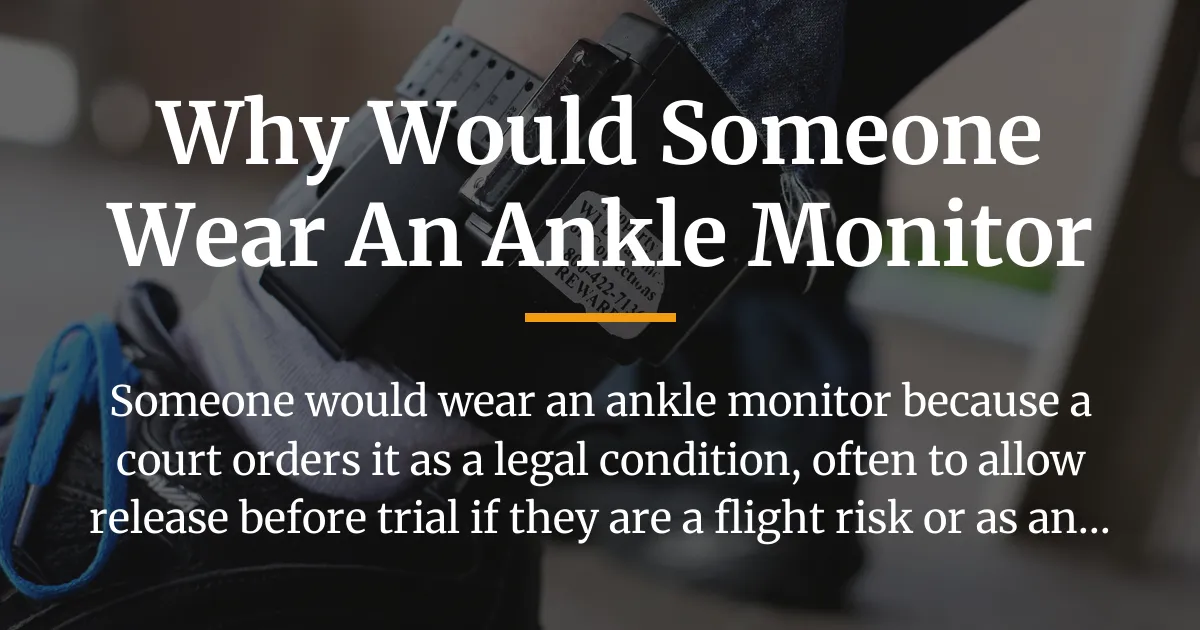
If you have ever found yourself asking, “why would someone wear an ankle monitor?” you are not alone. Spotting one in public sparks immediate curiosity and often concern. The device, a visible sign of the legal system, carries many assumptions. In reality, an ankle monitor is a tool used for multiple reasons, from ensuring someone appears in court to offering a second chance instead of jail. The answer involves layers of law, technology, and human experience. This article will guide you through the legal reasons, how the devices work, the daily life of wearers, and the bigger picture beyond the stereotypes.
Why Would Someone Wear an Ankle Monitor: The Legal Framework Unpacked
The core reason someone wears an ankle monitor is because a court or legal authority orders it. This order comes at different stages of the legal process, with distinct goals. Understanding these stages is key to making sense of the device on someone’s ankle. The law aims to balance individual rights, public safety, and practical solutions, leading to the use of monitoring in various situations.
The Pre-Trial Phase: Managing Risk Before a Verdict
Before a trial, a person is considered innocent until proven guilty. However, the court must decide if they can be trusted to remain in the community while awaiting their court dates. The two main concerns are whether the person might flee, known as flight risk, and whether they pose a danger to others. Judges use risk assessment tools to evaluate these factors based on the alleged crime, past behavior, and personal ties.
For individuals deemed a moderate flight risk or a potential concern for public safety, an ankle monitor becomes a condition of release. It allows them to leave jail but under strict supervision. This is common for charges like non-violent theft, fraud, or certain drug offenses where the person has stable employment or family but might be tempted to avoid court. The monitor ensures they stay within a defined area and appear for all legal proceedings.
In some cases, monitors are used to enforce protection orders. For example, if someone is accused of domestic violence, the court might order them to wear a monitor to ensure they do not approach the alleged victim’s home or workplace. This serves as a preventive measure, offering safety without full incarceration before the trial concludes.
The Post-Conviction Phase: An Alternative to Incarceration
After a person is convicted of a crime, the court determines the sentence. While jail time is a traditional penalty, ankle monitors are often used as part of alternative sentencing. This approach seeks to reduce jail overcrowding and allow rehabilitation within the community. It is frequently applied to non-violent offenses such as driving under the influence, probation violations, or low-level drug crimes.
House arrest is a common form of alternative sentencing involving an ankle monitor. The individual must remain at their residence except for pre-approved activities like work, medical appointments, or counseling. The monitor enforces this restriction, sending alerts if the person leaves without permission. This enables the wearer to maintain employment, support their family, and access treatment programs, which can be more beneficial than time behind bars.
Ankle monitors are also standard as a condition of probation or parole. Probation is a sentence served in the community instead of jail, while parole is early release from prison. In both, the wearer must follow specific rules, such as curfews or avoiding certain locations. The monitor provides a way for probation or parole officers to verify compliance without constant physical checks, facilitating a smoother reintegration into society.
Understanding Risk Assessment and Judicial Discretion
The decision to impose an ankle monitor hinges on a judge’s discretion, informed by risk assessments. These assessments score individuals based on factors like criminal history, community ties, and the nature of the offense. A low score might result in release without conditions, a medium score could lead to electronic monitoring, and a high score typically means jail. The monitor thus represents a middle path for those who need supervision but not confinement.
This system aims to tailor responses to individual circumstances. For instance, a first-time offender charged with a white-collar crime might receive a monitor to ensure court appearance, while someone with repeated offenses might be denied it. The goal is to use the least restrictive means necessary to meet legal objectives, which is why ankle monitors have become a versatile tool in modern justice.
The Technology Behind the Ankle Bracelet: More Than Just Tracking
Ankle monitors are not one-size-fits-all; they employ different technologies based on the legal requirements. Knowing how these devices function helps clarify their purpose and the experience of wearing one. From location tracking to behavior monitoring, the technology is sophisticated yet designed for reliability under daily conditions.
Primary Types of Monitoring Technology
The most common types are GPS monitors, radio frequency devices, and SCRAM systems. Each serves a unique function and is chosen according to the court’s goals for the wearer.
GPS monitors use global positioning satellites to track the wearer’s location in real time. They transmit data via cellular networks to a monitoring center, where software can set up geofences—virtual boundaries around allowed or prohibited areas. If the wearer crosses a geofence, an alert is triggered. This is useful for ensuring someone stays away from specific places, like a victim’s home, or remains within a city.
Radio frequency monitors rely on a base unit installed in the wearer’s home. The ankle device communicates with this unit through radio waves. If the wearer moves too far from the base, typically beyond a few hundred feet, an alert is sent. This system is often used for house arrest, where the primary requirement is to stay at home, with outings only by advance approval.
SCRAM devices focus on behavior rather than location. SCRAM stands for Secure Continuous Remote Alcohol Monitor. It tests the wearer’s sweat for alcohol consumption through the skin, taking samples at regular intervals and sending the data to a monitoring center. This is frequently ordered for DUI convictions to ensure sobriety as part of rehabilitation. Some advanced models combine GPS and SCRAM functions for comprehensive oversight.
| Type | Primary Use | How It Works | Typical Monitoring Authority |
|---|---|---|---|
| GPS Monitor | Real-time location tracking and geofencing | Uses satellite signals to pinpoint location; data sent via cellular networks to a center | Probation officer or private monitoring company |
| Radio Frequency Monitor | House arrest and curfew enforcement | Communicates with a home base unit; alerts if out of range | Similar to GPS, often with automated systems |
| SCRAM Device | Alcohol monitoring for DUI or sobriety orders | Measures alcohol concentration in sweat through skin contact; transmits data regularly | Specialized alcohol monitoring services or probation |
| Hybrid Device | Combined location and behavior monitoring | Integrates features like GPS and alcohol testing in one unit | Depends on jurisdiction and case requirements |
How Data is Monitored and Responded To
The data from ankle monitors is received by a monitoring center, which may be operated by government agencies or private companies. Staff at these centers watch for alerts indicating violations, such as geofence breaches, tamper attempts, or alcohol detection. When an alert occurs, they follow protocols, which often involve contacting the wearer or their supervising officer.
Probation or parole officers typically oversee the wearer’s case and review the data regularly. They use this information to ensure compliance with court orders. If a violation is confirmed, consequences can range from a warning to revocation of release and jail time. The technology is designed to be tamper-resistant, with features like anti-cut straps and internal sensors that trigger alerts if the device is manipulated.
Battery life is a critical aspect. Most devices require daily charging, often for several hours overnight. The wearer must plug the monitor into a charger, and during this time, their movement may be limited to the charger’s cord length. Failure to charge can lead to a dead battery, which may be treated as a violation, so adherence to charging schedules is essential.
The “Normal-Seeming” Person Wearing a Monitor: Busting the Stereotype
A common reaction to seeing an ankle monitor is to associate it with dangerous criminals. However, many wearers look like ordinary people—parents, professionals, or students—which contradicts stereotypes. This disparity arises because ankle monitors are used for a wide spectrum of individuals and offenses, not just violent crimes.
Examples of Everyday Wearers
Consider a middle-aged accountant accused of embezzlement. They have no history of violence and strong community ties, so the court releases them before trial with an ankle monitor to ensure they do not flee. They continue working and living at home, appearing normal to colleagues, but the monitor secures their court attendance.
Another scenario involves a single parent convicted of a first-time DUI. Instead of jail, they receive a sentence of house arrest with a SCRAM ankle monitor to enforce sobriety. This allows them to keep their job, drive children to school, and attend counseling, all while appearing like any other parent in the neighborhood.
In family court disputes, a parent might be ordered to wear a monitor to comply with custody arrangements, ensuring they do not approach the other parent without consent. This use is protective and administrative, not necessarily tied to criminal guilt, yet the wearer may seem entirely ordinary in daily life.
Why Appearance Does Not Indicate Severity
The legal system bases monitoring decisions on risk and behavior, not on how someone looks. A well-dressed professional could be under monitoring for a financial crime, while a casually dressed individual might be on house arrest for a minor probation violation. The device is a tool for managing legal obligations, not a uniform for dangerousness.
This understanding helps reduce stigma and promotes compassion. Recognizing that ankle monitors serve purposes like preventing flight or enabling rehabilitation allows us to see wearers as individuals navigating complex legal situations, rather than making assumptions based on appearance.
Life on a Monitor: Daily Rules, Restrictions, and Realities
Wearing an ankle monitor transforms daily life, imposing a structure of rules and constant awareness. The experience blends freedom with surveillance, affecting everything from routine chores to social interactions. Understanding this life sheds light on the practical implications of electronic monitoring.
The Daily Routine and Logistics
Each day begins with checking the device. Is it charged? Is it functioning properly? The wearer must plan around charging times, typically overnight, which can restrict movement to the bedroom or a small area. During the day, they must stay within approved zones, such as home, workplace, or treatment centers, as defined by geofences.
Any deviation from the schedule requires prior approval from the monitoring authority. A trip to the grocery store or a doctor’s appointment must be authorized in advance, often with specific time windows. Spontaneous activities are nearly impossible, adding a layer of stress to simple errands.
The device itself is bulky and visible, especially in warm weather. Wearers may choose clothing to conceal it, but this can be uncomfortable. They must also avoid activities that could damage the monitor, like swimming or contact sports, as submersion or impact might trigger false alerts or violations.
Social and Psychological Impacts
Social stigma is a significant burden. The visible monitor can lead to stares, questions, or avoidance from others, causing embarrassment and isolation. In workplaces, wearers might face discrimination or curiosity from coworkers, potentially affecting job performance and relationships.
Psychologically, the constant monitoring creates a sense of being watched, which can lead to anxiety, depression, and loss of privacy. Even false alerts—where the system mistakenly signals a violation—add to this stress, as wearers must often prove their innocence to authorities.
Financial costs are another reality. In many jurisdictions, wearers must pay fees for the monitoring service, which can range from a few dollars to over twenty dollars per day. These fees, on top of legal fines, can create heavy financial strain, particularly for those with limited income.
Navigating Employment and Family Life
Employment can be challenging, as some jobs are incompatible with ankle monitors. For example, roles in secure facilities, jobs requiring travel, or positions with physical demands might be off-limits. Wearers must seek employment that fits within their geographical restrictions and device requirements.
Family life is also affected. Curfews and location limits can hinder participation in family events, like children’s activities or gatherings. However, for many, the monitor allows them to remain with their family instead of in jail, which is a crucial benefit. Balancing these restrictions with family responsibilities requires careful communication and planning.
The Bigger Picture: Goals, Outcomes, and Controversies
Electronic monitoring is part of broader criminal justice strategies, with advocates praising its benefits and critics highlighting its flaws. Examining these perspectives reveals the complex role ankle monitors play in society.
The Promised Benefits of Electronic Monitoring
A primary goal is to reduce jail and prison overcrowding. By allowing non-violent offenders to remain in the community, monitoring saves taxpayer money on incarceration costs. It also minimizes the disruptive effects of jail, such as job loss and family separation, which can exacerbate recidivism.
Public safety is enhanced through targeted supervision. Monitors can prevent crimes by restricting wearers from certain areas or ensuring sobriety, providing a layer of protection for potential victims. This is especially valuable in domestic violence or stalking cases, where physical distance is crucial.
Rehabilitation is another key benefit. Wearers can access therapy, education, and employment while under supervision, addressing the root causes of their behavior. This approach aligns with modern justice reforms that emphasize redemption over punishment, helping individuals reintegrate successfully.
The Criticisms and Ethical Debates
Critics argue that electronic monitoring represents “net-widening,” extending state control to people who might otherwise have been released without conditions. This expansion of surveillance raises privacy concerns, as location and behavior data are collected continuously, potentially infringing on civil liberties.
The financial burden on wearers is a major ethical issue. Monitoring fees can be prohibitive, creating a system where wealthier individuals afford alternatives, while others accumulate debt or face jail for non-payment. This inequality challenges the notion of fair justice.
Effectiveness is debated. Studies on whether monitoring reduces recidivism show mixed results; some indicate positive outcomes, while others find no significant difference compared to traditional probation. Technical failures, like false alerts, can lead to unfair penalties, undermining trust in the system.
As of 2025, these debates continue amidst technological advancements. The growth of private monitoring companies introduces profit motives into justice, sparking discussions about commercialization. Balancing innovation with ethical oversight remains a critical challenge for policymakers.
Frequently Asked Questions About Ankle Monitors
This section addresses common queries based on the topics covered, providing concise answers and links to detailed explanations.
Can you shower or swim with an ankle monitor?
Most modern ankle monitors are waterproof for showers, so wearing them while showering is generally permitted. However, swimming is usually prohibited because prolonged submersion can interfere with the device’s signals or cause damage. Always follow the specific guidelines from your monitoring authority. For more on daily life with the device, refer to the section “Life on a Monitor: Daily Rules, Restrictions, and Realities”.
Who pays for the ankle monitor?
Often, the wearer is responsible for paying daily or weekly fees for the monitoring service, which can be a significant financial burden. In some cases, the cost is covered by the court or county, but this is less common. Payment structures vary by jurisdiction and individual circumstances. This topic is further explored in “The Bigger Picture: Goals, Outcomes, and Controversies”.
What’s the difference between an ankle monitor for house arrest and one for a DUI?
An ankle monitor for house arrest typically uses radio frequency or GPS technology to enforce geographical boundaries, ensuring the wearer stays at home except for approved outings. For a DUI, a SCRAM device is often used, which monitors alcohol consumption through sweat and does not track location. Some devices combine both functions. For a detailed comparison, see “The Technology Behind the Ankle Bracelet: More Than Just Tracking”.
Conclusion
In exploring why would someone wear an ankle monitor, we find a multifaceted answer rooted in law, technology, and human experience. Courts order these devices to manage risk before trial, offer alternatives to jail after conviction, and promote rehabilitation in the community. The technology ranges from GPS tracking to alcohol monitoring, each serving specific goals. Wearers come from all walks of life, challenging stereotypes, while daily life involves strict rules and social challenges. As criminal justice evolves, ankle monitors will remain a tool of both promise and debate, reflecting ongoing efforts to balance safety, fairness, and second chances. Understanding this complexity moves us beyond curiosity to a more informed perspective on this visible sign of the legal system.