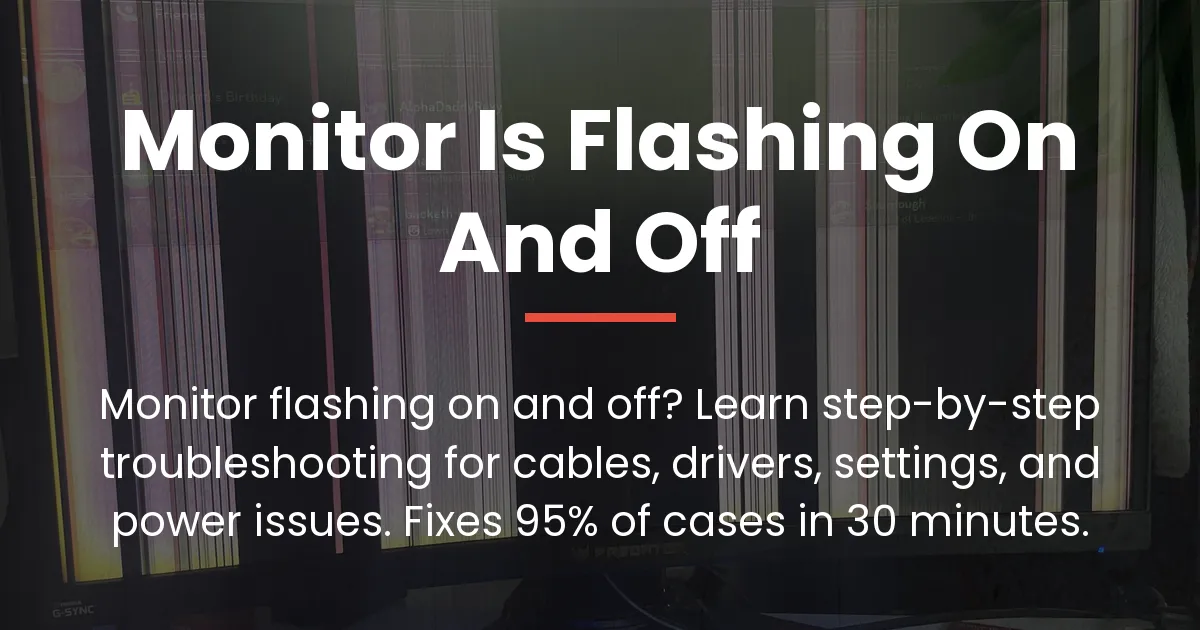
If you find yourself repeatedly asking, “why does my monitor keep going black,” you are experiencing a common yet disruptive problem that interrupts your workflow or entertainment without any clear pattern. This issue is not a mysterious glitch but rather a logical break in the communication between your computer and your display. Understanding this breakdown is the first step toward a permanent fix. This guide will empower you with the knowledge to interpret what your monitor is telling you, follow a clear elimination process to pinpoint the exact cause, and apply targeted solutions even for persistent cases that other guides overlook.
The Core Reason Your Monitor Loses Its Signal
Your monitor going black repeatedly is almost always a failure in the digital handshake within the video signal chain. Think of this chain as a continuous conversation between your computer’s graphics processor and your monitor’s internal circuitry. This conversation establishes critical details like resolution, color depth, and refresh rate the moment you turn on your devices. A stable handshake means a clear, consistent picture. When that handshake is interrupted or corrupted, the monitor loses its instructions and the screen goes dark.
The most crucial first clue in diagnosing this problem is your monitor’s power indicator light. Observing its behavior the instant the screen goes black tells you whether you are dealing with a signal loss or a power event. This simple observation splits the problem into two distinct paths and guides all future troubleshooting.
A signal loss is indicated when the monitor’s power light remains solid and lit, usually blue or white, while the screen is black. This means the monitor is receiving power and is technically “on,” but it is not receiving a valid video signal from your computer. The handshake has failed. Conversely, a power loss or reset is indicated when the monitor’s power light blinks, turns amber, or shuts off completely when the screen goes black. This suggests the monitor itself is cycling power or entering a standby mode, often due to an internal fault or an issue with its power supply.
For the common “keeps going black” issue that happens intermittently, the problem is most frequently a temporary signal loss. The handshake drops for a second and then may re-establish, which is why the screen might come back on its own after a few moments. This behavior directly links to the search for “black screen for a few seconds,” where the brief disruption is a hallmark of a shaky connection or a software conflict disrupting the signal protocol.
How the Video Signal Chain Breaks Down
Now that you know a broken signal chain is the core issue, it’s essential to understand where the weak links are. The chain has three primary points where failures occur: the physical connections, the software and drivers that manage the signal, and the hardware components that generate or display it. Each point fails in specific ways that cause the screen to go black.
Physical Links: Cables, Ports, and Adapters
The physical pathway is the most straightforward point of failure. A damaged or loose cable is a frequent culprit. Modern video cables like HDMI or DisplayPort contain many tiny wires for data and power. If the cable is frayed, bent too sharply, or has a weak connection at the port, it can lose contact on one or more pins. This partial connection might work well enough to establish a handshake initially but can fail when the cable is moved slightly or when a specific type of data is sent.
Ports on your computer, monitor, or a docking station can wear out over time. The metal contacts inside can become loose or accumulate dust, leading to an intermittent connection. Similarly, cheap or incompatible adapters, such as a USB-C to HDMI dongle, can struggle to convert the signal properly, causing dropouts. The issue is especially common in multi-monitor setups where the signal is being split or extended, adding more potential points of failure.
Software and Drivers: The Invisible Handshake Managers
Your operating system and graphics drivers are responsible for negotiating and maintaining the handshake. When software fails, it can corrupt this process. Outdated or corrupted graphics drivers are a top cause. The driver acts as a translator between your system and your graphics card. If it crashes or times out, the signal can cut out momentarily while the driver resets, leading to a black screen that often recovers after a few seconds.
Operating system power settings are another silent disruptor. Features like Windows Fast Startup or aggressive power-saving plans can put components to sleep incorrectly. For instance, a setting might turn off the display port to save power but then fail to wake it up properly, resulting in a black screen. Refresh rate conflicts also fall here. If a game or application tries to switch to a refresh rate your monitor cannot support, the handshake breaks, and the screen goes black until the previous stable setting is restored.
Hardware Components: The Source and Destination
Finally, the hardware at either end of the chain can be the root cause. Your graphics processing unit (GPU) might be overheating. When a GPU gets too hot, it can throttle its performance or shut down video output temporarily to prevent damage, causing the screen to go black. This is common during intensive tasks like gaming or video editing.
The monitor’s own internal components, like its power supply or scaler board, can degrade. A failing component might not provide stable power to the display panel, causing it to reset and the screen to go dark. In rare cases, your computer’s main power supply unit (PSU) might not be delivering consistent power to the GPU, leading to intermittent signal generation. Each hardware failure has a signature, but they all manifest as a break in the video signal chain you now understand.
A Step-by-Step Diagnostic Framework
Armed with the knowledge of how the signal chain breaks, you can now follow a logical, prioritized procedure to find your specific culprit. This framework is designed to test from the simplest, most common causes to the more complex ones. It eliminates guesswork by providing clear transitions. If a step does not resolve the issue, you move to the next one, systematically narrowing down the possibilities.
Phase 1: The Immediate Physical Checks
Begin with the physical layer because it is the easiest to test and often the source of the problem. First, ensure your computer and monitor are securely plugged into a working power outlet. Then, focus on the video cable. Power everything off completely. Unplug the video cable from both your computer and your monitor. Inspect the cable for any obvious damage, kinks, or bent pins. Firmly reseat the cable into both ports, ensuring it clicks into place if it has locking mechanisms.
If your monitor has multiple input ports, such as HDMI 1, HDMI 2, or DisplayPort, try switching to a different port on the monitor itself. Use the monitor’s on-screen display menu to select the new input source. This tests whether one specific port on the monitor is faulty. After reseating and checking ports, perform a full power cycle. Turn off and unplug both the monitor and computer from the wall for a full sixty seconds. This drains residual power and can clear temporary electronic glitches that corrupt the handshake. Plug everything back in and power on.
Phase 2: Isolating Software and Settings
If the physical checks yield no results, the issue likely lies in the software realm. Start by updating your graphics drivers, but do it cleanly. Simply installing a new driver over an old, corrupted one may not fix the problem. Use a tool like Display Driver Uninstaller in Windows Safe Mode to completely remove the current graphics driver. Then, download the latest driver directly from the website of your GPU manufacturer, such as NVIDIA or AMD, and install it fresh. This ensures no old files are interfering.
Next, adjust critical system settings. In Windows, navigate to the Power Options in the Control Panel. Edit your current power plan and set “Turn off the display” and “Put the computer to sleep” to “Never” temporarily for testing. More importantly, disable “Fast Startup.” This feature can prevent a clean shutdown of USB and display controllers, leading to handshake problems on the next boot. For laptop users with an external monitor, check the lid close action. Set it to “Do nothing” when plugged in to prevent the system from sleeping when you close the laptop lid, which often cuts signal to the external display.
Create a new user profile on your computer. Sometimes, corruption is isolated to a single user’s settings. Log into the new profile and see if the monitor blackout occurs there. If it does not, the problem is with your main profile’s configuration. Finally, if you are using a high refresh rate, try lowering it to a standard 60Hz via your graphics control panel to see if the monitor or cable struggles with the higher data rate.
Phase 3: Strategic Hardware Substitution
When software adjustments fail, you must test the hardware components by substitution. The goal is to swap each part of the chain with a known-good alternative. Begin with the video cable. Replace your current HDMI or DisplayPort cable with a different, high-quality cable that you know works. Do not assume a new cable is good; use one that is actively working on another setup. Cable quality varies greatly, and a poor-quality cable may not handle the bandwidth required for your resolution and refresh rate.
Next, test with a different monitor. Connect your computer to another television or monitor. If the problem disappears, your original monitor is likely at fault. If the problem persists on the new display, the issue is with your computer or cable. To isolate further, test your monitor with a different video source, like a gaming console or another laptop. If the monitor works fine with another source, the problem is confirmed to be with your original computer. For desktop users, if you have an integrated GPU on your motherboard, remove the dedicated graphics card and connect the monitor to the motherboard’s video output. If the blackouts stop, the dedicated GPU or its PCIe slot is the problem.
The Definitive Hardware Isolation Test
If you have progressed through all the previous phases and your monitor still keeps going black, you face a complex, persistent issue that requires conclusive testing. This is where most guides stop, leaving users in a cycle of replacing parts randomly. The definitive hardware isolation test is designed to eliminate all variables and pinpoint the failing component with certainty. It addresses the common frustration of users who have tried new cables and monitors without success.
This test involves creating a minimal, clean system environment. For a desktop computer, open the case and ensure all internal connections are secure. Remove any non-essential components like extra hard drives or expansion cards. Use a single, known-good video cable that is certified for high speed, such as an HDMI 2.1 or DisplayPort 1.4 cable. Connect it directly from your graphics card to your monitor, bypassing any docking stations, switches, or adapters. If possible, use the integrated graphics on your CPU by removing the dedicated GPU entirely for this test.
On the software side, perform a clean boot of your operating system. In Windows, use the System Configuration tool to disable all startup programs and non-Microsoft services. This rules out third-party software interference. Even better, if you can, boot from a live Linux USB drive. This completely isolates the problem from your Windows installation. If the monitor works perfectly in this stripped-down Linux environment, the issue is definitively within your Windows software or drivers. If the blackouts persist even in this minimal state, you have isolated the problem to a fundamental hardware fault.
The final step is environmental testing. Overheating can be intermittent. Monitor your GPU temperatures using software like HWMonitor while running a stress test. If the screen goes black precisely as the temperature peaks, overheating is the cause. Likewise, test with a different power supply unit in your desktop if possible. A failing PSU can provide unstable power to the GPU, causing signal drops. This level of testing moves beyond common fixes and provides the evidence needed to confidently replace a specific component, ending the guesswork.
Frequently Asked Questions About Monitor Black Screens
These questions address specific scenarios that users often encounter. The answers apply the principles from the diagnostic guide concisely, providing direct solutions without rehashing the full procedure.
Why does my monitor go black for a second when switching tabs or games?
This brief black screen is typically a mode switch triggered by your GPU driver or an application. When you switch from a desktop application to a full-screen game, or when a game changes resolution or refresh rate, the graphics driver renegotiates the handshake with the monitor. If the driver is buggy or the monitor is slow to respond, this can cause a one-second signal loss. The fix involves updating your graphics drivers to the latest stable version and, within the graphics control panel, setting a global refresh rate instead of letting applications change it automatically. Refer to the software isolation phase in the diagnostic framework for detailed steps on managing drivers and settings.
Why does my external monitor go black when I close my laptop lid?
This behavior is controlled by your Windows power plan settings, not a hardware fault. By default, Windows is set to put the laptop to sleep or turn off the display when you close the lid to save power. To keep your external monitor active, you must change this setting. Go to Control Panel, open Power Options, and click “Choose what closing the lid does.” For both “On battery” and “Plugged in” states, set the “When I close the lid” option to “Do nothing.” This instructs Windows to keep running and sending a signal to the external monitor even when the laptop lid is closed. This solution is part of the software adjustments covered in the diagnostic framework’s second phase.
Why does my monitor say “no signal” then go black on my PS5 or Xbox?
This is a pure signal chain issue between your console and monitor, confirming the core principle explained earlier. Consoles can sometimes output a resolution or refresh rate that your monitor does not support, causing a handshake failure. To fix this, boot your console in safe mode. For a PlayStation 5, turn off the console, then hold the power button until you hear a second beep to access safe mode. From there, you can reset the display settings to a default, compatible mode like 1080p. Ensure you are using a high-speed HDMI cable that came with the console or is certified for HDMI 2.1. Test different HDMI ports on your monitor. The fundamental process of checking physical connections and resetting the source device’s settings mirrors the initial steps of the diagnostic guide.
Understanding why your monitor keeps going black transforms a frustrating mystery into a solvable technical challenge. The problem consistently stems from a disruption in the careful dialogue between your computer and your display. By first observing the simple clue of your monitor’s indicator light, you can categorize the issue. Following the systematic diagnostic framework moves you from quick physical checks through software adjustments to conclusive hardware tests. For those stubborn cases that defy common fixes, the definitive hardware isolation test provides the final answer. This logical progression ensures you are not just applying random fixes but are identifying and resolving the root cause, restoring a stable and reliable connection to your digital world.