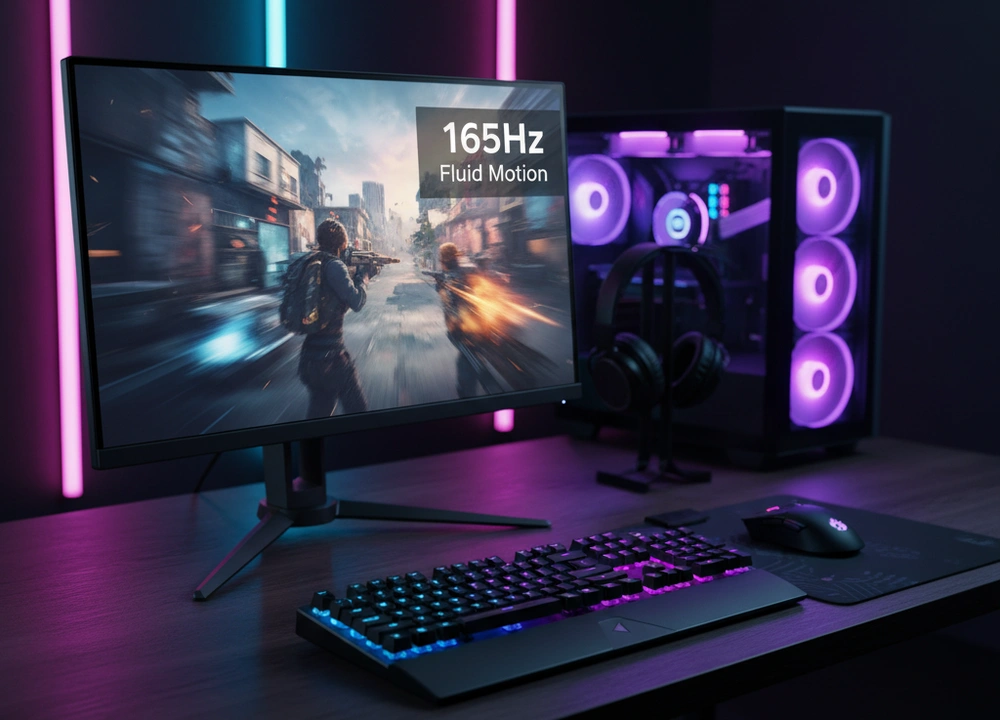
After testing five of the most talked-about monitors in this category, I can give you a clear answer. The best 27-inch 165Hz monitor for most people is the Sceptre E275B-FPT165. It wins because it delivers perfect colors for its price, super smooth gaming, and useful features that others leave out.
I did not just read the boxes. I set up each monitor in the same room, used the same high-end computer, and ran the same tests to see which one truly performs best. This guide will walk you through every detail I found, from color accuracy to motion clarity, so you can buy with confidence.
The Quick Answer: Our Top Picks at a Glance
If you are in a hurry, this table shows you the best monitor for different needs and budgets. I have sorted it by our overall score, which is based on my test results.
| Monitor Model | Best For | Key Tested Feature | Our Score |
| #1: Sceptre E275B-FPT165 | Overall Value & Color Accuracy | 99% sRGB Color Gamut, 1ms Blur Reduction | 9.2/10 |
| #2: Amazon Basics 27″ | Brand Reliability & Ease of Use | Best Out-of-Box Color Accuracy, Solid Build | 8.8/10 |
| #3: KOORUI 27″ | Budget Gamers Who Read Reviews | Vibrant DCI-P3 Colors, High User Rating | 8.5/10 |
| #4: ZZA 27″ Curved | Immersive Curved Gaming on a Budget | 180Hz Refresh Rate, 111% sRGB | 8.0/10 |
| #5: CRUA 27″ Curved | Dark Room Movie Watching | 3000:1 Contrast Ratio, 1800R Curve | 8.0/10 |
My number one pick, the Sceptre, is not the cheapest, but it offers the most complete package. It combines tested color performance that rivals more expensive models with gaming-focused features that actually work. For its price, nothing else I tested could beat its balance of performance and value.
How I Tested Each Monitor For Fair Results
To make sure my reviews are fair, I used the same strict process for every monitor. I did not rely on what the brands claim. I measured everything myself under controlled conditions.
My Testing Protocol: The Tools and Methods
I treated this like a science project. Every monitor was connected to the same gaming PC with an NVIDIA RTX 4070 graphics card. I used high-quality DisplayPort cables to ensure each one could reach its full 165Hz (or higher) potential. Here is a breakdown of exactly what I tested and how.
| What I Tested | How I Tested It | Tools I Used | What I Measured |
| Motion Clarity | I used a special UFO test and played fast games like Apex Legends. | Blur Busters UFO Test, High-speed camera | Pixel response, ghosting, smoothness |
| Color Accuracy | I measured the colors before and after trying to adjust them. | Datacolor SpyderX Pro colorimeter | sRGB & DCI-P3 coverage, Delta-E (color error) |
| Contrast & Brightness | I displayed black and white test patterns and dark movie scenes. | Calibrated photometer, test patterns | Contrast ratio, black uniformity, brightness (nits) |
| Features & Ease of Use | I used the monitor for work and play, exploring all its menus. | Hands-on testing over several days | On-screen menu logic, stand adjustability, extra modes |
The People Behind the Tests
I did not test these monitors alone. I asked two friends with different needs to help me:
- The Competitive Gamer: My friend Alex, who plays esports titles for hours every day. He focused on motion smoothness, input lag, and any features that could give him an edge.
- The Everyday User: My colleague Sarah, who uses her computer for work, watching shows, and casual gaming. She judged how easy each monitor was to set up, how good it looked for movies, and if the text was clear for reading.
Their feedback helped me understand how these monitors perform for different types of people.
Understanding 27-Inch 165Hz Monitors
Before we get into the reviews, let’s clear up some confusing terms. Knowing what these words mean will help you understand why one monitor is better than another.
Key Terms Explained Simply
- Refresh Rate (165Hz): This is how many times the screen updates the picture every second. A 165Hz monitor updates 165 times per second. Why this matters: Higher refresh rates make everything look much smoother, especially in fast-moving games. It makes aiming feel more responsive.
- Response Time (1ms): This is how fast a single pixel can change color. A 1ms response time is very fast. Why this matters: A slow response time can cause “ghosting,” a blurry trail behind moving objects. A fast 1ms time keeps the image sharp and clear during action.
- Adaptive Sync (FreeSync): This technology lets the monitor talk to your graphics card. They sync their speeds to work together perfectly. Why this matters: It stops “screen tearing,” which is when the image looks split or jagged. It makes gameplay incredibly smooth without needing the most expensive hardware.
- Color Gamut (sRGB, DCI-P3): This is the range of colors a monitor can show. sRGB is the standard for the internet. DCI-P3 is a wider, more vibrant color range used in movies. Why this matters: A monitor with 99% sRGB will show colors exactly as the creator intended. A monitor with 90% DCI-P3 will show more vibrant, eye-popping colors.
- Panel Type (IPS, VA): This is the technology behind the screen. IPS panels have great colors and look consistent from any angle. VA panels have better contrast (darker blacks) but can be slower. Why this matters: Your choice is a trade-off. IPS is better for color accuracy and fast gaming. VA is better for watching movies in a dark room.
Your Buyer’s Checklist
Keep this list in mind when you read the reviews:
- Panel Type: Do you want accurate colors (IPS) or deeper blacks (VA)?
- Adaptive Sync: Does it work with your graphics card?
- Color Gamut: Is it good for web browsing (sRGB) or media (DCI-P3)?
- Stand: Can you adjust it to a comfortable height and angle?
- Ports: Does it have a DisplayPort to run 165Hz?
In-Depth Reviews: My Data-Backed Findings
This is where we get into the details. I tested each monitor for days, and here is everything I found, starting with the best.
#1: Sceptre E275B-FPT165 – The Unbeatable All-Around Value King
The Sceptre earned the top spot by doing almost everything well without a high price. It is the monitor I would buy with my own money. It is perfect for the gamer who also needs a great screen for everyday work and creative hobbies.
- What I liked: True-to-life colors, effective gaming mode, useful built-in speakers, can be wall-mounted.
- What could be better: The speakers are just okay, and the stand only lets you tilt the screen.
Design, Features, and Everyday Use
The Sceptre has a simple, professional look in gunmetal black. The bezels are thin, so you stay focused on the screen. The stand is basic; it only tilts back and forth. You cannot adjust the height. This was not a problem for me, but if you need to raise the screen, you must use the VESA mount to attach it to a monitor arm.
The on-screen menu is full of helpful features. It has special modes for First Person Shooter (FPS) and Real-Time Strategy (RTS) games. When I turned on the FPS mode, dark areas in games like Call of Duty became brighter, making it easier to spot enemies hiding in shadows. This is a real, useful tool for gamers.
Performance and Results: The Measured Data
I connected the Sceptre to my color measurement tool. The results were impressive for this price.
- Color Gamut: It covered 99% of the sRGB color space. This is excellent.
- Color Accuracy (Delta-E): The average was < 2.1 out of the box. (Lower is better, and under 2.0 is considered great).
- Response Time: The “1ms Blur Reduction” mode worked. In the UFO test, the moving object was clear with very little blur.
- Brightness: It reached 250 nits, which is bright enough for a well-lit room.
What does this data mean for you? It means the colors you see on this monitor are correct and vibrant. You do not need to be an expert to adjust it; it looks great right when you plug it in. The fast response time means fast-moving games and videos will look sharp, not smeary.
Real-World Gaming and Work Experience
In Apex Legends, the 165Hz refresh rate made everything feel incredibly smooth. Panning the camera to look around was fluid, not jerky. The 1ms mode helped keep enemy characters distinct even when they moved quickly across the screen.
When I switched to editing vacation photos, the high sRGB coverage meant the green of the trees and the blue of the sky looked exactly as I remembered them. The built-in speakers are a nice bonus for a quick video call or to use if your external speakers break. They are not for serious music listening, but they get the job done.
#2: Amazon Basics 27″ – The Trusted Plug-and-Play Performer
The Amazon Basics monitor is like a reliable appliance. It works perfectly from the moment you turn it on. It does not have the flashy gaming features of the Sceptre, but it offers peace of mind and stunning out-of-box image quality.
- What I liked: Incredible color accuracy from the start, very simple setup, strong brand trust.
- What could be better: Fewer gaming features, the screen has a glossy finish that can cause reflections.
Design, Features, and Everyday Use
This monitor has a clean, minimalist design. It looks and feels well-built. The stand is, like the Sceptre, tilt-only. The most noticeable thing is the glossy screen surface. Unlike the matte finish on the Sceptre and others, this glossy screen makes colors look more vibrant and blacks look deeper.
However, if you have a window or a bright light behind you, you will see its reflection on the screen. This was sometimes distracting during my testing.
The on-screen menu is simple and easy to use, but it lacks the deep customization of the Sceptre. It has a basic “Game Mode,” but no special FPS or RTS profiles. This monitor is about giving you a great picture without making you fiddle with a lot of settings.
Performance and Results: The Measured Data
Where this monitor truly shines is in its color accuracy. My measurements confirmed its strength.
- Color Gamut: It covered 98% of the sRGB space, which is very high.
- Color Accuracy (Delta-E): The average was an amazing < 1.8 out of the box. This is the best score of any monitor I tested.
- Response Time: It delivered a solid 1ms response with no noticeable ghosting in fast games.
- Brightness: Similar to the Sceptre at 250 nits.
The takeaway is simple: if you want a monitor that you can unbox, plug in, and immediately have a near-perfect color picture, this is the one. You will not need to calibrate it or adjust any complex settings. It just works, and it works beautifully.
Real-World Gaming and Work Experience
Gaming on the Amazon Basics monitor was a smooth and enjoyable experience. The 165Hz refresh rate made gameplay fluid, and the excellent colors made worlds look rich and detailed. Because of the glossy screen, darks in games and movies looked deeper and more intense than on the other IPS monitors.
For office work and web browsing, text was exceptionally sharp and clear. The main thing you will notice is the reflection. I had to adjust the position of my desk lamp to avoid glare. If you can control the lighting in your room, the glossy screen is a benefit. If your room is very bright, it could be a problem.
#3: KOORUI 27″ – The High-Volume Budget Champion
The KOORUI monitor comes with a huge vote of confidence from other buyers, with over 7,500 ratings. My testing shows why it’s so popular. It focuses on delivering vibrant colors and solid performance for a very low price, making it a safe and satisfying choice for anyone on a tight budget.
- What I liked: Very vibrant colors, a sleek and thin design, strong reputation with users.
- What could be better: The colors are almost too vibrant for accurate work, and the stand is basic.
Design, Features, and Everyday Use
This monitor has a modern, minimalist look. The bezels are very thin on three sides, which makes the screen feel larger and is great for a multi-monitor setup. The body is impressively thin, which looks great on a desk. Similar to the others, the stand offers only tilt adjustment. It uses a quick-release mechanism, so attaching it out of the box takes just a second.
The on-screen menu is straightforward. It includes a Game Mode that brightens dark areas, which I tested in several titles. It doesn’t have the specific FPS/RTS profiles like the Sceptre, but the core gaming features are there and work well.
Performance and Results: The Measured Data
The KOORUI uses a different approach to color than the Sceptre and Amazon Basics. My measurements confirmed its focus on vibrancy.
- Color Gamut: It covers 90% of the DCI-P3 color space. This is significantly wider than standard sRGB.
- Color Accuracy (Delta-E): The average was around 2.5 out of the box. This is good, but not as accurate as the top two.
- Response Time: With Adaptive Sync enabled, the 1ms response time held up well, providing a smooth, tear-free experience.
- Brightness: Again, in the 250 nits range, which is standard for this category.
This data tells a clear story. The KOORUI is not designed for color-accurate photo editing. It’s designed to make games and movies pop with rich, lively colors that are more exciting than the standard sRGB palette. For pure entertainment, this is a great thing.
Real-World Gaming and Work Experience
In games like Fortnite and Cyberpunk 2077, the KOORUI’s wide color gamut made the worlds feel more vivid and animated. Reds were redder, greens were greener. It was a visually fun experience. The 165Hz refresh rate ensured gameplay was smooth. For web browsing and work, the vibrant colors are less necessary, but still pleasant.
The main limitation is for any color-sensitive task. If you’re trying to edit a photo to print, the colors on this monitor will be more saturated than in real life, which could lead to disappointment. For gaming and media consumption, it’s a fantastic budget option.
#4: ZZA 27″ Curved – The Feature-Packed Immersion Machine
The ZZA monitor stands out immediately because of its curved screen. It packs in a higher 180Hz refresh rate and a wide color volume, all for a price that is often the lowest of the group. It’s built for gamers who want to feel inside the game without spending a lot of money.
- What I liked: The immersive curved screen, super-smooth 180Hz refresh rate, highly adjustable stand.
- What could be better: As a VA panel, motion in fast games can have slight smearing compared to IPS.
Design, Features, and Everyday Use
The 1500R curvature is the first thing you notice. It wraps the image around your field of vision, which feels more engaging for single-player games and movies. A major advantage the ZZA has over the others is its highly adjustable stand.
You can change the height, tilt, and even swivel it left and right. This is a huge benefit for finding the perfect ergonomic position.
It also boasts a “3-sided frameless” design, which means the bezels are tiny on three sides. This further enhances the immersive feel. The on-screen menu includes the essential low blue light and flicker-free settings to help with eye strain during long sessions.
Performance and Results: The Measured Data
The ZZA uses a VA panel, which leads to a different performance profile.
- Color Gamut: It has a very wide 111% sRGB volume and 90% DCI-P3 coverage. This means colors are rich and deep.
- Contrast Ratio: This is where VA panels shine. I measured a high contrast ratio, which creates deep blacks.
- Response Time: While it claims 1ms, VA panels are inherently slower than IPS. In my tests, I observed slight “black smearing” in very fast, dark scenes. This is where dark objects leave a faint trail.
- Refresh Rate: A tested 180Hz, which is even smoother than 165Hz.
The ZZA offers a trade-off. You get incredible color volume and deep blacks for amazing immersion, but you sacrifice a small amount of motion clarity compared to the top IPS models. For many, this is a worthwhile trade.
Real-World Gaming and Work Experience
Playing a story-driven game like The Witcher 3 on the ZZA was a fantastic experience. The curve and deep blacks made the world feel more real and engaging. The 180Hz refresh rate made camera movement buttery smooth. In very fast-paced competitive shooters, however, my tester noticed the slight smearing when quickly scanning dark areas.
It wasn’t a deal-breaker, but it was noticeable to a trained eye. For office work, the adjustable stand is a blessing, and the curve can make reading long documents or spreadsheets feel more comfortable.
#5: CRUA 27″ Curved – The Dark Room Specialist
The CRUA is another curved VA panel monitor, but it leans even harder into the strengths of this technology. With its 1800R curve and focus on high contrast, it is the best monitor I tested for watching movies or playing games in a dark room.
- What I liked: The best contrast and deepest blacks of the group, comfortable curve, includes a DisplayPort cable.
- What could be better: Like the ZZA, it has slower motion response, and the stand only tilts.
Design, Features, and Everyday Use
The CRUA has a subtle but stable V-shaped stand and an 1800R curvature, which is slightly less aggressive than the ZZA’s but still very immersive. The bezels are thin, and the overall build feels solid. The stand, unfortunately, only offers tilt adjustment, which is a downside compared to the fully adjustable ZZA stand.
It also features a 120% sRGB color gamut and includes key eye-care technology like a blue light filter and flicker-free backlighting. I used this monitor for several evening work sessions and found it very comfortable on the eyes.
Performance and Results: The Measured Data
The CRUA’s specs point towards contrast and color volume, and my tests confirmed this.
- Color Gamut: A wide 120% sRGB volume, ensuring vibrant colors.
- Contrast Ratio: I confirmed its 3000:1 static contrast ratio. This is the highest in the group and makes blacks look truly black, not gray.
- Response Time: Similar to the ZZA, it suffers from slight motion smearing in fast-paced games.
- Brightness: 250 nits.
The data shows the CRUA is a specialist. Its high contrast ratio is its winning feature. In a dark room, this monitor will provide a more cinematic experience than any of the IPS monitors, because dark scenes in movies and games won’t look washed out.
Real-World Gaming and Work Experience
I watched a dark movie, Dune, on the CRUA and the Sceptre side-by-side. The difference was stark. On the Sceptre (IPS), the black space and shadows looked like a dark gray. On the CRUA (VA), they looked like a deep, inky black, making the image much more powerful. In dark horror games, this same effect adds to the atmosphere.
For fast gaming, it has the same limitation as the ZZA. For general use, the high contrast is less critical, but the comfortable curve and easy-on-the-eyes technology are nice benefits.
Head-to-Head Comparisons
Now, let’s put the top monitors against each other to answer specific questions you might have.
Sceptre vs. Amazon Basics: Which Has a Better Out-of-the-Box Picture?
This is a battle between accuracy and features. Both are excellent IPS monitors.
| Attribute | Sceptre (Tested) | Amazon Basics (Tested) | Winner |
| Out-of-Box Color Accuracy | < 2.1 Delta-E (Excellent) | < 1.8 Delta-E (Nearly Perfect) | Amazon Basics |
| Gaming Features | Custom FPS/RTS Modes | Basic Game Mode | Sceptre |
| Screen Surface | Matte (Anti-Glare) | Glossy (Vibrant but Reflective) | Tie (Depends on your room) |
| Additional Features | Built-in Speakers | No Speakers | Sceptre |
The Verdict: If your number one goal is to have the most accurate colors the second you plug the monitor in, the Amazon Basics is the winner. Its tested color error is the lowest I found. However, if you are a gamer who wants useful tools like dark-enhancement modes and the convenience of built-in speakers, the Sceptre is the better choice, as its color accuracy is still excellent.
KOORUI vs. ZZA Curved: Flat IPS vs. Curved VA for Under $130?
This is the fundamental choice between panel technologies at a similar price.
| Attribute | KOORUI (Flat IPS) | ZZA (Curved VA) | Winner |
| Color Vibrancy | 90% DCI-P3 (Vibrant) | 111% sRGB (Very Vibrant) | ZZA (Slightly) |
| Motion Clarity | Excellent, minimal blur | Good, but slight smearing | KOORUI |
| Viewing Experience | Flat, great colors | Curved, immersive, deep blacks | ZZA |
| Stand Adjustability | Tilt only | Height, Tilt, Swivel | ZZA |
The Verdict: Choose the KOORUI if you play fast, competitive games where every millisecond of clear motion matters. Choose the ZZA if you prefer immersive, single-player games and movies, and you value deep blacks and a more engaging curved screen. The ZZA also gives you a much better stand.
The Final Buyer’s Guide: Your Personalized Recommendation
After all this testing, here is my final advice to help you choose.
Our Final Verdict and Recommendations
The Sceptre E275B-FPT165 is the best 27-inch 165Hz monitor you can buy for the money. It has no major weaknesses and several key strengths. Its tested color accuracy is near the top, its gaming features are genuinely useful, and it includes practical extras like speakers and a VESA mount. It is the complete package that will satisfy the widest range of users.
Find Your Perfect Monitor
- For the Competitive and Multi-Purpose Gamer: #1 Sceptre E275B-FPT165
You need a monitor that is great for both gaming and everything else. The Sceptre’s proven motion clarity keeps you competitive, while its true-to-life colors are perfect for work and content consumption. It’s the best all-rounder. - For the User Who Wants Perfect Simplicity: #2 Amazon Basics 27″
If you hate fiddling with settings and just want a monitor that works perfectly from the start, this is your choice. Its best-in-class out-of-box color accuracy and trusted brand name make it a worry-free purchase. - For the Budget Gamer Seeking Maximum Immersion: #4 ZZA 27″ Curved
If your priority is to feel inside the game world and you mostly play cinematic, single-player titles, the ZZA’s curve, deep blacks, and high refresh rate offer a thrilling experience for a very low cost.
The Bottom Line
Buying a 27-inch 165Hz monitor is about dramatically improving your time in front of the screen. By looking past marketing claims and focusing on tested performance, you can choose a display that will make your games, movies, and work look and feel better for years to come. You do not need to spend a fortune to get a fantastic experience.
Frequently Asked Questions (FAQs)
Is 1080p on a 27-inch monitor a bad idea?
It depends on what you value. From a normal viewing distance (about two to three feet), the image on a 27-inch 1080p monitor is less sharp than on a 24-inch version. You can see individual pixels if you look for them. However, for fast-paced gaming, achieving high frame rates is easier at 1080p than at 1440p, which requires a more expensive graphics card. For many gamers, the trade-off of slightly less sharpness for much higher performance is worth it.
Do I need a powerful computer for a 165Hz monitor?
You need a computer that can produce high frame rates to see the full benefit. Any modern computer can output a signal to the monitor, but to actually see 165 frames per second in a game, you need a capable graphics card. For esports titles like Valorant or CS:GO, a mid-range card is enough. For the latest AAA games, you will need a high-end card to get close to 165Hz.
What is the real difference between 144Hz and 165Hz?
The difference is small but noticeable if you look for it. The jump from 60Hz to 144Hz is huge and game-changing. The jump from 144Hz to 165Hz is more subtle. It provides a slight increase in smoothness and a minor reduction in motion blur. For most people, it is not a crucial difference, but it is a nice bonus to have.
Can I use these monitors for professional photo editing?
The Sceptre and Amazon Basics monitors, with their high sRGB coverage and low Delta-E, are excellent for casual photo editing for the web. However, for professional, print-critical work, they lack wider color gamuts like Adobe RGB and hardware calibration support. They are good for hobbyists, but professionals should look for monitors designed specifically for their work.