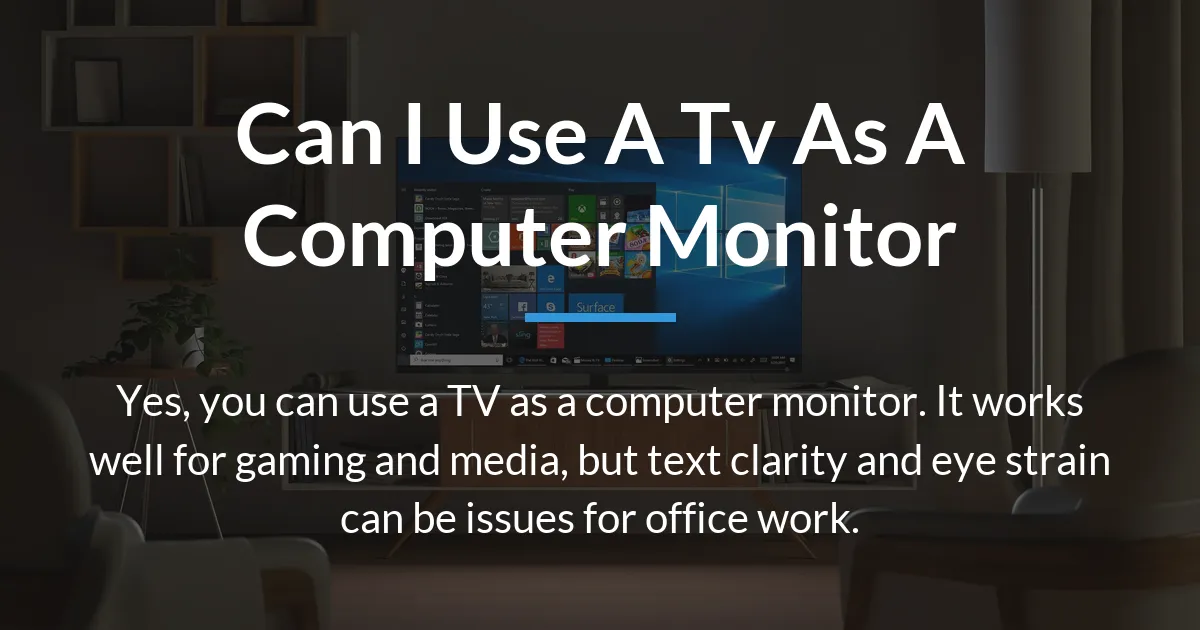
The question of whether you can use a TV as a computer monitor is common. The simple answer is yes, but the real experience depends on what you do. This guide explains the full picture. We cover how to connect, the good and bad points, and how to set it up right for your needs.
Can I Use a TV as a Computer Monitor
Yes, you can use a TV as a computer monitor. Physically connecting them is easy with an HDMI cable. Most modern TVs and computers have HDMI ports.
However, the experience is not the same as using a real computer monitor. For some tasks, a TV is a great option. For other tasks, it can lead to a poor experience.
The key is to know the difference. A TV is made for watching shows from across the room. A monitor is made for sitting close and reading text. This basic fact shapes everything.
Many people use TVs as monitors for the large screen. It can turn a living room into a gaming station. But for daily work, a dedicated monitor is often better.
This section gives you the core answer. The rest of the guide dives into the details. You will learn what to expect and how to decide.
What You Need to Connect a TV to a Computer
Connecting a TV to a computer is straightforward. You need a few basic things. The most important item is an HDMI cable.
HDMI is the standard for this job. It carries both video and audio signals. This means one cable can handle picture and sound.
Check your computer’s output ports. Most desktops and many laptops have an HDMI port. If your computer has one, you are ready to go.
Some laptops only have USB-C or DisplayPort ports. In that case, you need an adapter. A USB-C to HDMI adapter is common and cheap.
On the TV side, look for an HDMI input. Almost all TVs made in the last ten years have at least one HDMI port. It is usually on the back or side.
You do not need a special or expensive HDMI cable. Any standard cable that supports your desired resolution will work. For example, for 4K resolution, a basic HDMI 2.0 cable is fine.
Once connected, you might need to change some settings. But the physical connection is simple. Just plug one end into the computer and the other into the TV.
Turn on both devices. Use the TV remote to select the correct HDMI input. Your computer screen should appear on the TV.
If it does not work, do not worry. We will cover troubleshooting in the setup section. The first step is just to make the link.
Advantages of Using a TV as a Monitor
Using a TV as a monitor has clear benefits. These advantages make it attractive for certain users. The biggest plus is screen size.
A large TV, like 55 inches or more, offers an immersive view. For gaming, this can be amazing. You see more of the game world and feel inside it.
Watching movies and videos is also better on a big screen. The experience is more like a home theater. This is great for media consumption.
Cost is another advantage. Sometimes, a large TV is cheaper than a large computer monitor. You get more screen for your money.
This cost per inch ratio can be very good. It makes a TV a budget-friendly choice for a big display.
TVs often come with built-in speakers. This means you do not need to buy separate speakers. It saves money and reduces clutter on your desk.
The sound quality from TV speakers is usually decent for casual use. For serious audio, you might still want external speakers. But for most people, the built-in ones are enough.
Smart TVs add more convenience. They have apps like Netflix and YouTube built in. You can switch between your computer and streaming apps easily.
For gaming, many new TVs have features that help. Low input lag is crucial for fast games. A high refresh rate makes motion smoother.
Some TVs even have Variable Refresh Rate or VRR. This syncs the TV’s refresh rate with your computer’s output. It reduces screen tearing for a better experience.
Models like the LG C2 OLED are popular for this reason. They offer a great experience for PC gaming. The picture quality is also top-notch.
In summary, a TV can be a great option for gaming and media. It gives you size, features, and often a good price.
Why Text and Desktop Work Often Suffer
Despite the advantages, using a TV for text work is hard. The main problem is text clarity. Text on a TV often looks fuzzy or blurry.
This happens because of pixel density. Pixel density means how many pixels are in one inch of screen. Monitors have high pixel density for sharp text up close.
TVs have lower pixel density. They are made to be watched from several feet away. When you sit close, you can see the pixels, and text loses sharpness.
Even on a 4K TV, which has many pixels, the density might be low if the screen is very large. A 65-inch 4K TV has bigger pixels than a 27-inch 4K monitor. So text is not as crisp.
Another issue is TV image processing. TVs use tricks to make videos look better. These include motion smoothing and sharpening.
For video, these features can be good. But for static computer images, they are bad. They can make text edges blur or look unnatural.
Chroma subsampling is a technical reason for fuzzy text. TVs often use a compressed color signal to save bandwidth. This compression reduces color accuracy for fine details like text.
To fix this, you need to enable a PC or Game mode on the TV. This mode turns off compression and uses full color. We will cover how to do this in the setup section.
Eye strain is a common complaint. TV brightness and contrast are set for videos, not for reading. Staring at a bright TV screen up close can cause headaches.
The response time of a TV can be slower than a monitor. Response time is how fast a pixel can change color. Slow response time can make mouse movements feel laggy.
This lag is frustrating for precise tasks like clicking small buttons or editing text. For gaming, input lag is different, but for desktop work, response time matters.
In short, TVs are not designed for text. They lack the pixel density and proper settings for clear reading. This is why many people find it a poor experience for office work.
Choosing the Right TV for Computer Use
If you want to use a TV as a monitor, picking the right one is key. Your choice should match your main activity. Different uses need different features.
For gaming, look for a TV with low input lag. Input lag is the delay between your button press and the action on screen. Lower is better for fast games.
A high refresh rate is also important. Refresh rate is how many times the screen updates per second. A rate of 120Hz or higher allows smoother gameplay.
Variable Refresh Rate or VRR support is a bonus. It helps prevent screen tearing. Many modern gaming TVs have this.
OLED TVs like the LG C2 are excellent for gaming. They have fast response times and great picture quality. But they can be expensive.
For media and casual use, focus on picture quality. Look for good color accuracy and HDR support. HDR makes colors pop and improves contrast.
Screen size matters here too. A bigger TV is better for movies. But make sure it fits your space and viewing distance.
For office work or as a work monitor, it is tricky. You need a TV with good text clarity. This means high resolution and the ability to disable image processing.
Look for TVs that have a dedicated PC mode. This mode optimizes settings for computer use. Some brands like Samsung and LG offer this.
Viewing distance is critical. If you use a TV on a desk, you sit close. A very large TV might be too big for comfortable viewing.
A 40-inch TV might be the max for a typical desk. Anything larger and you will need to move your head to see the edges. This can cause neck strain.
Consider the price. TVs can be cheaper than monitors, but high-end models are not. Set a budget and compare options.
Read reviews from other users. See if people report good experiences using the TV as a monitor. Pay attention to comments about text clarity and lag.
Brands like LG, Samsung, and Vizio have models that work well. But not all models are equal. Check the specific model number for computer use feedback.
In summary, match the TV to your task. For gaming, prioritize performance. For media, prioritize picture. For work, be cautious and test if possible.
How to Set Up a TV as a Computer Monitor
Setting up a TV as a computer monitor requires care. It is more than just plugging in a cable. Follow these steps for the best experience.
Start by preparing your devices. Turn off both the TV and the computer. This avoids any electrical issues during connection.
Connect the HDMI cable from your computer to the TV. Use the correct ports. On the TV, note which HDMI input you use, like HDMI 1 or HDMI 2.
Now, turn on the TV first. Then turn on your computer. This order helps the TV detect the signal properly.
Use the TV remote to select the HDMI input you connected to. You should see your computer screen on the TV.
If the screen is blank, do not panic. The computer might be outputting a resolution the TV does not support. We will fix this.
First, adjust the TV settings. Go to the TV’s picture settings menu. Look for a mode called Game Mode or PC Mode.
Enable this mode. It reduces input lag and turns off most image processing. This is crucial for clear text and responsive control.
Next, turn off any motion smoothing or motion interpolation features. These are often under advanced settings. They cause blurring for computer use.
Also, turn off any sharpening or edge enhancement. These can make text look worse. Set sharpness to zero or a low value.
Set the color temperature to Warm or Standard. Avoid Vivid or Dynamic modes. They are too bright and colorful for close viewing.
Now, go to your computer’s display settings. On Windows, right-click the desktop and select Display settings. On Mac, go to System Preferences and choose Displays.
Set the resolution to the TV’s native resolution. For example, if it is a 4K TV, set it to 3840 x 2160. This ensures the sharpest image.
Adjust the scale and layout. For large TVs, you might need to scale up text and apps. This makes them readable from a close distance.
But be careful. Too much scaling can make things look blurry. Start with the recommended scale and adjust as needed.
Check the color output. Ensure your computer is set to Full RGB range. This improves color accuracy. You can find this in your graphics card control panel.
For Nvidia cards, open the Nvidia Control Panel. For AMD, use the Radeon settings. Look for output color format and set it to RGB.
Test the setup. Open a document with small text. See if it looks clear. Move the mouse around to check for lag.
If text is still fuzzy, go back to TV settings. Ensure PC mode is on. Some TVs have a setting for HDMI input label. Change it to PC or Computer.
For sound, set the TV as the default audio device on your computer. This sends sound through the TV speakers.
Fine-tune for comfort. Adjust brightness based on your room light. Lower brightness in a dark room to reduce eye strain.
Consider using a blue light filter at night. Both Windows and Mac have built-in night light features. This can help with eye comfort.
If you have issues like a black screen, try restarting both devices. Also, try a different HDMI cable or port. Sometimes, a faulty cable causes problems.
For multiple monitors, you can use the TV as a second screen. In display settings, choose Extend these displays. Then drag windows between your main monitor and the TV.
This setup process ensures the best experience. It addresses common problems like blurry text and lag. Follow each step carefully.
Frequently Asked Questions
Can I use a TV as a computer monitor for my laptop?
Yes, you can use a TV as a monitor for your laptop. Connect them with an HDMI cable. If your laptop has only USB-C, use a USB-C to HDMI adapter. The setup is the same as for a desktop.
Is using a TV as a monitor bad for your eyes?
It can be, due to low pixel density and bright screens. To protect your eyes, sit at a proper distance, lower brightness, and take breaks. For long reading sessions, a monitor is better.
Can you use a Smart TV as a monitor without lag from its apps?
Yes, but use the TV’s PC or Game mode to minimize lag. Avoid running smart apps on the TV while connected to a computer, as this can cause delays. Use the computer for all tasks.
Will using my Samsung TV as a monitor wear out the OLED pixels faster?
OLED TVs can suffer from burn-in if static images are displayed for long periods. To prevent this, use screen savers, hide taskbars, and vary content. This is especially important for desktop use.
Can I use a TV as a second monitor alongside my regular monitor?
Yes, this is a common setup. Connect the TV to your computer and set it as an extended display. You can use it for extra windows, media playback, or gaming while working on the main monitor.
Is a 4K TV better as a monitor than a 1080p TV?
Yes, a 4K TV has higher resolution, which improves text clarity and detail. However, for close viewing, pixel density still matters, so a 4K TV is better but may not match a 4K monitor for sharpness.
Why does my TV screen go black when I connect my computer?
This is often due to a resolution or refresh rate mismatch. Reboot both devices, and set your computer to a lower resolution first, then adjust to the TV’s native resolution in display settings.
Can I use a TV as a monitor for photo or video editing?
It can work, especially if the TV has accurate colors and HDR support. However, monitors are calibrated for color accuracy. For professional editing, a monitor is preferred, but a high-end TV can be a good secondary screen.
Do I need a special HDMI cable to connect a TV as a monitor?
No, a standard HDMI cable is sufficient for most uses. For 4K at 60Hz or higher, use an HDMI 2.0 cable or later. Expensive cables do not improve picture quality for digital signals.
Are some TV brands better for use as a computer monitor?
Yes, brands like LG and Samsung have models with good PC modes and low input lag. OLED TVs from LG are popular for gaming. Research specific models for computer use reviews before buying.
In the end, the decision to use a TV as a computer monitor depends on your needs. For gaming and media, it offers a large, immersive screen. For text-based work, the compromises in clarity and comfort are real. By understanding the trade-offs and setting up correctly, you can make an informed choice. Whether for a living room setup or a desk, know what to expect and enjoy the big screen when it fits your task.