If you are asking, “Can I use my desktop monitor with my laptop?” the answer is a clear and simple yes. This setup is not only possible but also a fantastic way to give yourself more screen space for work or play. You likely have everything you need already, and the process is easier than you might think. We will guide you through the entire journey, from plugging in the cable to mastering your new expanded workspace.
Know Your Ports and What They Do
Before you buy any cables, you must look at the ports on your laptop and your monitor. This step is crucial because not every port can send a video signal. The shape of the port is just one part of the story. What really matters is the video signal it can carry, which is its function.
Common video output ports on laptops include HDMI, USB-C, and sometimes DisplayPort or older VGA. Your desktop monitor will have input ports like HDMI, DisplayPort, DVI, or VGA. A USB-C port on your laptop might look like a simple charging port, but it could also carry a video signal. This capability is often called DisplayPort Alt Mode or is part of a Thunderbolt connection.
To help you identify what you have, here is a simple guide to the most common ports.
| Port Name | What It Looks Like | Key Capability | Adapter Needed For |
|---|---|---|---|
| HDMI | A flat, wide slot with angled corners. | Carries high-definition video and audio in one cable. | Connecting to a monitor with only DisplayPort or VGA. |
| USB-C | A small, oval-shaped port. | May carry video, data, and power. Not all USB-C ports output video. | Connecting to almost any other monitor port via a dock or adapter. |
| DisplayPort | A rectangle with one corner cut at an angle. | Carries high-quality video and audio, often used for gaming or professional monitors. | Connecting to an HDMI or VGA monitor. |
| VGA | A blue port with three rows of tiny holes. | Carries an older analog video signal. Does not carry audio. | Connecting to a modern HDMI or DisplayPort monitor. |
Check your laptop’s manual or specifications online if you are unsure about your USB-C port’s capabilities. Some high end laptops have Thunderbolt ports, which are very versatile and can output video. The goal is to match the video signal from your laptop to an input your monitor can understand.
Choose the Right Cable or Adapter
Once you know your ports, choosing the correct cable becomes straightforward. The rule is simple: connect the video output from your laptop to the video input on your monitor. If the ports on both devices match, you only need a standard cable. If they do not match, you will need an adapter or a special cable that converts the signal.
For example, if your laptop has a USB-C port that supports video and your monitor has an HDMI port, you can use a USB-C to HDMI cable. If your laptop has HDMI and your monitor has DisplayPort, you need an HDMI to DisplayPort adapter or cable. Always buy cables from reputable brands to ensure good quality and reliable performance.
In some cases, a docking station is a better choice than a single cable. A dock plugs into your laptop’s USB-C or Thunderbolt port and gives you multiple ports at once. You can connect your monitor, a keyboard, a mouse, and other devices through one connection. This is excellent for a clean desk setup and makes it easy to connect and disconnect your laptop.
Connect and Configure Your Display
With the correct cable in hand, you are ready to set everything up. Follow these steps to get your monitor working with your laptop.
Step 1: Make the Physical Connection
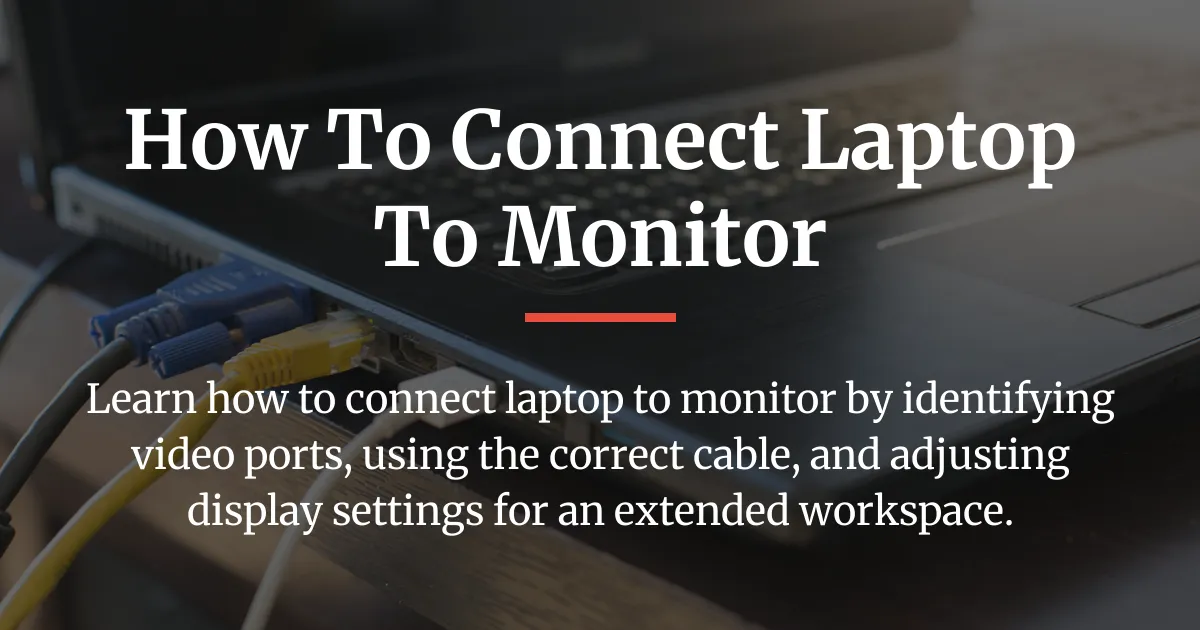
First, turn off your laptop and monitor to avoid any electrical issues. Plug one end of your cable into your laptop’s video output port. Then, plug the other end into your monitor’s correct input port. Ensure the connections are snug and secure.
Step 2: Power On Your Devices
Turn on your desktop monitor first. Use its menu or source button to select the correct input, like HDMI 1 or DisplayPort. Then, power on your laptop. Your laptop should automatically detect the new monitor after a moment.
Step 3: Adjust Your Display Settings
Your operating system will allow you to control how the screens work together. On Windows, press the Windows key and P at the same time to open a quick menu. On a Mac, go to System Settings and then Displays. You will see a few important options.
You can choose to duplicate your laptop screen, which shows the same thing on both displays. The extend option gives you more desktop space, letting you drag windows between the two screens. You can also set the external monitor as your only display, which is useful if you want to close your laptop lid.
Step 4: Fine-Tune Resolution and Scale
For the sharpest picture, you may need to adjust the resolution. Go to your system’s display settings and select the external monitor. Choose the recommended resolution, which is usually the native resolution of your monitor. If text looks too small or too big, use the scaling slider to make everything more readable.
Optimize Your Dual-Screen Workspace
Getting a picture is just the beginning. To truly benefit from your desktop monitor, you should arrange it for your specific tasks. A good setup can boost your productivity and comfort.
Start by arranging the displays in your system settings to match their physical placement on your desk. If your monitor is to the left of your laptop, drag the screen icon to the left in the settings. This makes moving your mouse between screens feel natural.
Setup for Office Work and Multitasking
Set your larger desktop monitor as your primary display for your main tasks. Use your laptop screen for reference materials, chat windows, or music players. Learn keyboard shortcuts for snapping windows to the sides of the screen. This helps you organize multiple apps quickly without dragging them around.
Setup for Gaming and Media
For gaming, set the external monitor as your main display and close your laptop lid for immersion. Ensure your game is running on the monitor with the highest refresh rate for smoother motion. Be aware that some input delay can occur with certain adapters, so a direct HDMI or DisplayPort connection is often best.
Setup for Creative Work
If you do design or coding, color accuracy might be important. Check if your monitor has different color profiles and calibrate it to match your laptop screen if needed. Use the extra space to keep your tools on one screen and your canvas or code on the other.
Remember to position your monitors so the top of the screen is at or slightly below eye level. This reduces neck strain. Using an external keyboard and mouse with your laptop on a stand can create a very comfortable and efficient desk.
Why Using a Laptop Screen as a Monitor Is Difficult
You might wonder if you can do the reverse: use your laptop screen as a monitor for another computer, like a desktop PC. This is a different and much harder problem. Your laptop is designed to output a video signal easily, but its internal screen is not built to accept an external signal.
A laptop display receives a proprietary signal from the laptop’s internal hardware. It does not use a standard connection like normal HDMI or DisplayPort. To use it as a monitor, you would need to find the exact panel type inside your laptop and buy a special controller board from a place like AliExpress. This is a technical, risky, and often expensive process.
There are software workarounds, like using remote desktop or streaming apps such as Mouse Without Borders. These let you control another computer from your laptop, effectively using its screen. However, this introduces some input delay and requires a network connection. For most people, buying a cheap display is a much easier and better solution in the long run.
Fix Common Problems
Sometimes, things do not work perfectly on the first try. Here are solutions to the most frequent issues people face.
No Signal Message on the Monitor
If your monitor says “No Signal,” first check that all cables are firmly connected. Ensure the monitor is set to the correct input source. Try restarting both the laptop and the monitor. Test with a different cable or port if possible. Also, verify that your laptop’s video output port is working by connecting it to another screen.
Blurry Text or Wrong Resolution
Blurry text usually means the resolution or scaling is set incorrectly. Go to your display settings and select the recommended resolution for the external monitor. Then, adjust the scaling percentage until text looks crisp and clear. Make sure you have installed the latest graphics drivers for your laptop.
Audio Not Playing Through the Monitor
If your monitor has speakers but no sound is coming out, you need to change the audio output device. On Windows, click the speaker icon in the taskbar and select your monitor’s name from the list. On a Mac, go to System Settings, then Sound, and choose the monitor as the output device.
Laggy or Stuttering Display
A laggy display can be caused by a slow adapter or a high-resolution monitor overloading your laptop’s graphics. Try using a direct cable connection instead of an adapter. Lower the monitor’s refresh rate or resolution in the display settings. For gaming, close other programs to free up system resources.
Frequently Asked Questions
Can I connect my laptop to a monitor without an HDMI port?
Yes, you can use other ports like USB-C, DisplayPort, or even VGA with the correct adapter or cable. The key is matching the video signal from your laptop to an input your monitor understands.
Will using an external monitor slow down my laptop?
Using one external monitor usually does not slow down a modern laptop. However, driving multiple high-resolution monitors or gaming on a big screen can use more graphics power, which might affect performance if your laptop has limited hardware.
Can I close my laptop lid while using an external monitor?
Yes, you can. In your power settings, set the laptop to “Do nothing” when the lid is closed. Then, in display settings, set the external monitor as your only display before closing the lid.
Why is my external monitor blurry or the wrong resolution?
This is typically because the display settings are using a non-native resolution or incorrect scaling. Select the recommended resolution for your monitor in system settings and adjust the scale for clarity.
Can I use two or more desktop monitors with my laptop?
Many laptops can support two or more external monitors, especially if they have a powerful USB-C or Thunderbolt port that can connect to a docking station. Check your laptop’s specifications to see how many displays it can handle.
Does connecting a monitor drain my laptop battery faster?
If the monitor is powered by your laptop’s USB-C port, it can drain the battery. Using a monitor with its own power supply or a docking station that provides power to your laptop will not drain the battery and can even charge it.
My monitor says “no signal” even when connected. What now?
Check all cable connections, ensure the monitor is on the correct input source, and restart both devices. Try a different cable or port. Also, make sure your laptop’s video output is enabled and not disabled in the BIOS or UEFI settings.
Can I use a very old VGA monitor with a modern laptop?
Yes, but you will need an active adapter that converts your laptop’s digital signal (like from HDMI or USB-C) to the analog VGA signal. These adapters are inexpensive and widely available.
Is a docking station better than just using a cable?
A docking station is better if you want to connect multiple peripherals like monitors, keyboards, and drives with one plug. It creates a neat workstation. A single cable is simpler and cheaper if you only need to connect one monitor.
Can I use my Apple Macbook with a Windows PC monitor?
Absolutely. Monitors are not specific to operating systems. Any monitor with HDMI, DisplayPort, or USB-C will work with a MacBook. You might need a USB-C to HDMI or DisplayPort adapter if your MacBook does not have those ports.
Conclusion
Using your desktop monitor with your laptop is a straightforward upgrade that anyone can do. With the right cable and a few settings adjustments, you can enjoy a larger screen for work, gaming, or browsing. Remember to check your ports, choose the correct cable, and take the time to optimize your setup for your tasks. So, if you were wondering, “Can I use my desktop monitor with my laptop?” you now know not only that you can, but exactly how to do it well.