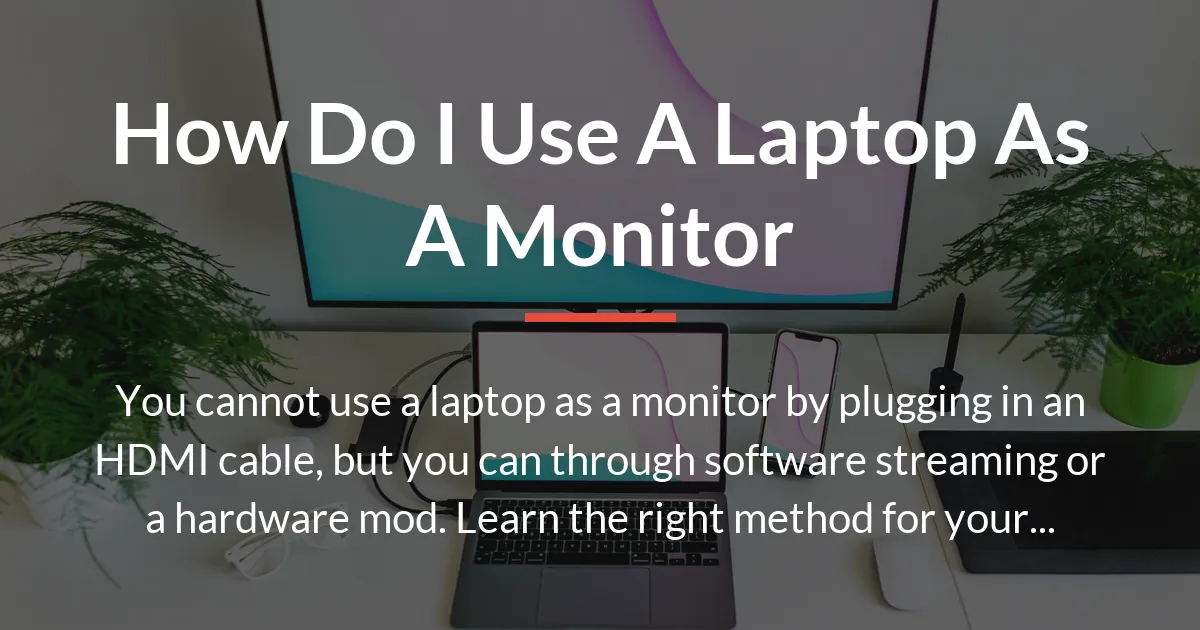
If you’ve ever searched for how do i use a laptop as a monitor, you’ve likely found confusing and conflicting advice online. Some sources say it’s impossible, while others offer complicated workarounds. This article cuts through the noise to give you the clear, complete truth and a practical path forward based on what you actually need.
Why You Can’t Just Plug a Cable Into Your Laptop
The biggest misunderstanding comes from the ports on your laptop. Your laptop’s HDMI or USB-C port is designed only for output, which means it sends video out to another screen like a TV or external monitor. It cannot accept video input from another device like a game console or a second computer.
This is the hardware limitation that makes a simple cable connection impossible. Think of it like a faucet that only pours water out; you can’t use it to fill a bucket from another source. Without a dedicated input port, your laptop lacks the basic wiring to function as a standalone display.
What Makes a Laptop Screen Different
To understand why, you need to know what a laptop screen really is. A standard external monitor is a self-contained unit with circuits that accept common video signals through ports like HDMI. Your laptop’s display, however, is an integrated panel directly connected to the motherboard with a special cable, often using LVDS or eDP protocols.
This connection is proprietary and meant only for the laptop’s own graphics system. It’s not built to receive standard HDMI or DisplayPort signals from outside. So, even if you could open up your laptop, you wouldn’t find a port to plug into; you’d find a ribbon cable that talks only to its original computer.
The Two Ways to Use a Laptop as a Monitor
Since a direct cable connection is off the table, you have two broad families of solutions. The first method uses software to stream the screen over your network, effectively turning your laptop into a wireless secondary display. The second method is a hardware conversion that involves physically removing the LCD panel and connecting it to a special controller board that adds video inputs.
Software streaming is a digital workaround that requires no extra hardware but depends on your network speed and software compatibility. Hardware conversion is a physical modification that transforms the bare LCD into a standalone monitor, but it requires technical skill and additional parts.
Choosing the Best Method for Your Setup
This is where most guides fail—helping you decide which method makes sense for your specific situation. Your choice hinges on what device you want to connect and what you plan to do with it.
For extending your Windows or Mac desktop to get more screen space for work, software streaming is your only realistic option. It works well for tasks like writing, coding, or browsing where a slight delay isn’t critical. If you want to connect a game console like an Xbox, PlayStation, or Nintendo Switch, software methods won’t work because consoles can’t run the required streaming apps.
In that case, only the hardware modification is technically possible, but for most people, buying a cheap portable HDMI monitor is a smarter and easier investment. For a hobby project with a Raspberry Pi or an old laptop you don’t mind tinkering with, the hardware mod can be a fun and viable way to repurpose the screen.
Decision Guide at a Glance
Use software streaming if you have two computers and need an extra desktop for office work. Consider hardware conversion only if you have technical skills and a spare laptop screen for a custom project. For consoles, look into affordable portable monitors instead.
Step-by-Step Guide to Software Screen Sharing
This method uses built-in features in Windows or macOS to project your primary computer’s screen to your laptop. Here is a universal procedure that works for most setups.
1. Prepare Both Computers on the Same Network
Ensure both your primary computer and the laptop you want to use as a monitor are connected to the same Wi-Fi network. A wired Ethernet connection can improve stability, but Wi-Fi is sufficient for basic tasks.
2. Enable Projection Settings on the Laptop
On the laptop that will act as the monitor, go to your system settings. In Windows, open Settings > System > Projecting to this PC and set it to “Available everywhere” or “Secure only.” On a Mac, ensure AirPlay Receiver is enabled in Displays settings.
3. Connect From the Primary Computer
On your main computer, open the projection menu. In Windows, press Windows Key + P and select “Connect to a wireless display,” then choose your laptop from the list. On a Mac, click the AirPlay icon in the menu bar and select your laptop.
4. Adjust for Extended Display or Mirroring
Once connected, you can choose to duplicate your screen or extend your desktop to the laptop. For productivity, extending gives you more space to drag windows between screens.
The Big Drawback of Software Streaming
While software streaming is convenient, it comes with significant limitations that are often glossed over. The most critical issue is input lag, which is the delay between your action on the primary computer and what you see on the laptop screen.
This lag is caused by the time it takes to encode, transmit, and decode the video signal over the network. Even on a fast network, you might notice a slight stutter or delay, making it unsuitable for fast-paced gaming, video editing, or any task requiring real-time response.
Additionally, video quality can suffer from compression artifacts, especially if your network is busy. The experience is entirely dependent on your network stability, so if Wi-Fi drops, so does your connection.
How the Hardware Modification Works
The hardware conversion method bypasses the laptop’s internal system entirely. It involves disassembling the laptop to remove the LCD panel, then connecting it to a universal controller board that you purchase separately.
This controller board acts as a translator, converting standard HDMI input into the signal the LCD panel understands. You’ll need to identify the exact model of your laptop screen to buy a compatible board, which usually costs between $20 and $50.
The process requires careful disassembly, soldering small cables in some cases, and mounting the board and panel into a new frame or stand. It’s a rewarding project for engineering students or tech hobbyists, but it’s not recommended for casual users due to the risk of damaging the screen.
Frequently Asked Questions
Can I use my laptop as a monitor for my PlayStation or Xbox with an HDMI cable?
No, you cannot use your laptop as a monitor for your PlayStation or Xbox with an HDMI cable because laptops lack HDMI input ports. The only theoretical way is through hardware modification, but a portable HDMI monitor is a better choice.
Is there any way to use a laptop as a monitor without installing software?
Without software, the only alternative is the hardware conversion method, which requires physical modification and a controller board. There is no plug-and-play cable solution for using a laptop as a monitor.
Will using my laptop as a second monitor for my PC slow down either computer?
Software streaming uses network resources and some processing power, which might slightly slow down both computers, especially on older hardware. For basic tasks, the impact is minimal, but for resource-intensive applications, you might notice a performance dip.
Can I use a broken laptop that won’t turn on as just a monitor?
If the laptop is broken but the LCD panel is undamaged, you can potentially use it as a monitor through the hardware conversion method. You’ll need to remove the screen and connect it to a controller board, as the internal computer parts are no longer functional.
How do I use a laptop as a monitor for a Nintendo Switch?
You cannot directly use a laptop as a monitor for a Nintendo Switch via cable or standard software. The Switch doesn’t support screen streaming apps. Hardware modification is possible, but investing in a portable display with HDMI input is far more practical.
Is the hardware conversion method safe for my old laptop?
The hardware conversion method is safe if done correctly, but it voids any warranty and carries a risk of damaging the LCD panel during disassembly. It’s best attempted on old laptops you’re willing to repurpose or discard otherwise.
Why does my wireless projection to my laptop have a delay?
Wireless projection to your laptop has a delay due to network latency and the time required for video encoding and decoding. This input lag is inherent to software streaming methods and cannot be eliminated completely, even on fast networks.
Can I use a MacBook as a monitor for a Windows PC?
Yes, you can use a MacBook as a monitor for a Windows PC through software streaming using built-in features like AirPlay or third-party apps. Ensure both devices are on the same network and follow similar steps as for Windows-to-Windows projection.
What is the cheapest way to get a second monitor if my laptop won’t work?
The cheapest way to get a second monitor is often to buy a used standalone monitor from local listings or online marketplaces. These can be found for similar or lower cost than attempting to repurpose a laptop screen, with better reliability and performance.
Does using my laptop as a monitor damage its battery or screen?
Using your laptop as a monitor via software streaming does not damage its battery or screen, as it’s just displaying video like normal. Hardware modification, if done improperly, could damage the screen, but proper usage won’t cause harm.
Final Thoughts and Recommendations
In summary, learning how to use a laptop as a monitor depends entirely on your goal. For most people seeking extra screen space for work, software streaming is a handy free tool, despite its lag. For connecting game consoles or building projects, hardware mods exist but are niche.
Before you dive in, consider that a budget external monitor often provides a smoother experience than repurposing a laptop. But if you’re determined, now you have the knowledge to choose the right path and set realistic expectations. Use this guide to make an informed decision and avoid the frustration that comes from misleading advice online.