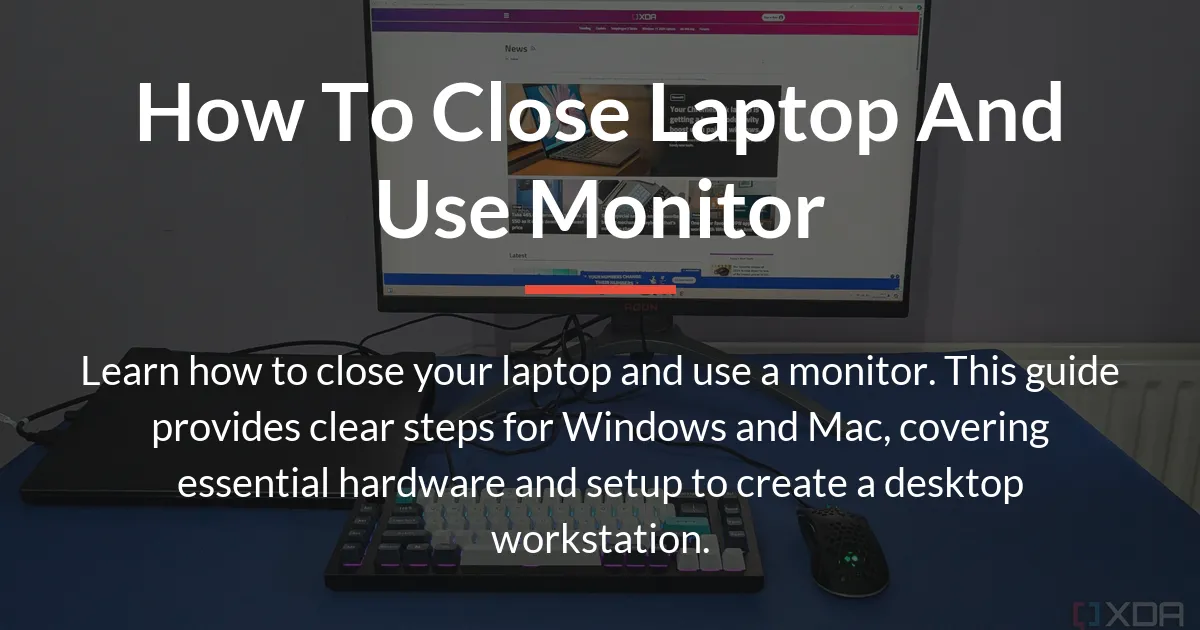
You can absolutely close your laptop and use a monitor as your main screen. This turns your portable computer into a clean and powerful desktop setup.
You just need to connect the right hardware and change one key setting on your laptop. This guide walks you through the entire process, from plugging in cables to fixing common problems.
What It Means to Close Your Laptop and Use a Monitor
When you close your laptop and use a monitor, you are putting your computer into a special mode. This mode is often called clamshell mode or lid closed mode.
In this mode, your laptop screen turns off. Your external monitor becomes the only display you see. You control everything with an external keyboard and mouse.
Your laptop itself stays on and runs all your programs. It just uses the bigger screen and better tools you connected to it. This is perfect for turning a small laptop into a full desktop computer at your desk.
The Most Important Rule
For this to work, your laptop must be plugged into power. The laptop needs its power adapter connected to the wall.
This is a firm rule for almost every laptop. Running on battery while the lid is closed can cause problems. The computer might go to sleep or shut down to save power.
So, the first step is always to plug in your laptop. Then you can connect everything else.
What You Need to Get Started
You cannot start the software steps until you have the right hardware. Gathering these items first will make the whole process smooth.
Missing just one piece can stop the setup from working. Here is the complete list of what you need.
Essential Hardware for Your Setup
You will need five main things. These are the external monitor, a video cable, an external keyboard, an external mouse, and your laptop’s power adapter.
Your external monitor can be any normal desktop screen. The video cable must connect your laptop to this monitor.
The external keyboard and mouse let you control your laptop when the lid is shut. They plug into your laptop’s ports, often through a USB connection. Your laptop’s own power adapter is non-negotiable. You must use it.
Understanding Video Cables and Ports
This is a step many guides skip. You must connect your monitor to the correct port on your laptop with the right cable.
Look at the sides of your laptop. You need to find the video output port. Common types are HDMI, DisplayPort, and USB-C.
HDMI ports look like thin, wide slots. DisplayPort ports look similar but have one corner cut at an angle. USB-C ports are small and oval.
You need a cable that matches your laptop’s port on one end and your monitor’s port on the other. For example, a USB-C to HDMI cable. Using the wrong cable means your monitor will not show a picture.
The Advantage of a Docking Station
A docking station is a simple box that sits on your desk. You plug all your hardware into the dock just once.
You connect your monitor, keyboard, mouse, and power adapter to the dock. Then, you use a single cable from the dock to your laptop.
This one cable provides power, video signal, and data for your mouse and keyboard. It is the cleanest way to set up your desk. When you want to leave, you unplug just one cable and take your laptop with you.
The Correct Order for Setup
Following the steps in the right order prevents frustration. If you do these steps out of sequence, your monitor might stay black.
The key is to connect all hardware first. You must make the laptop see the monitor before you change any settings or close the lid.
Step-by-Step Connection Guide
First, plug your laptop into the wall using its power adapter. Make sure it is charging.
Second, connect your external monitor to your laptop using the correct video cable. Then, turn the monitor on. Use the monitor’s buttons to select the correct input source, like HDMI 1.
Third, connect your external keyboard and mouse to your laptop’s USB ports. If your keyboard or mouse is wireless, plug in its wireless receiver.
Fourth, power on your laptop if it is off. If it is on, just wait. You should see your laptop’s desktop appear. It might show on both your laptop screen and the external monitor at this point. That is normal and good.
Fifth, and only after you see your desktop on the external monitor, you can move to the software settings. Now you are ready to tell your computer what to do when you close the lid.
How to Close Laptop and Use Monitor on Windows
The process is very similar for Windows 11 and Windows 10. You need to find the Power Options menu in the Control Panel. This is where the lid closing setting is located.
Finding the Settings in Windows 11
Click the Start button or press the Windows key on your keyboard. Then click on the Settings icon, which looks like a gear.
Inside Settings, click on “System” on the left side. Then, click on “Power & battery”. Look for a section called “Screen and sleep”.
Next to that section, you will see a link that says “Additional power settings”. Click this link. It will open the classic Power Options window from the Control Panel. This is the window you need.
Changing the Lid Closing Action
In the Power Options window, you will see a list of tasks on the left side. Click on the one that says “Choose what closing the lid does”.
A new screen will appear. You will see two columns: “On battery” and “Plugged in”. Under each column is a menu next to “When I close the lid”.
For the “Plugged in” column, click the menu. Change the setting from “Sleep” to “Do nothing”. It is a good idea to also change the “On battery” setting to “Do nothing” for testing, but remember you should always be plugged in for this to work well.
After you select “Do nothing”, you must click the “Save changes” button at the bottom of the window. If you do not save, the setting will not change.
The Final Test
Once you have saved the new setting, you are ready. Simply close your laptop lid gently.
Your laptop screen will go dark. After a second, your external monitor should flash and then show your full desktop. You can now use your external keyboard and mouse to work.
Your laptop is running with the lid closed. You are only using the external monitor. The setup is complete.
How to Close MacBook and Use Monitor
Apple calls this feature “Clamshell Mode”. The process for a MacBook is often simpler than for Windows, but the rules are strict.
MacBook Clamshell Mode Requirements
Your MacBook must be connected to a power source. It cannot be on battery.
You must have an external keyboard and mouse connected *before* you close the lid. A MacBook’s own keyboard and trackpad will not work to wake the computer when the lid is closed.
You also need your external monitor connected and turned on. Once all these things are connected, the mode works almost automatically.
Entering Clamshell Mode on a Mac
Make sure your MacBook is awake and showing your desktop on its own screen. Your external monitor might also be on and showing a screen.
You do not need to change any system settings like on Windows. The setting is built in.
Simply close your MacBook lid. The moment you close it, the laptop’s screen will turn off. The external monitor will become the main and only display.
On some older MacBooks, you may need to press a key on your external keyboard or click your external mouse after closing the lid to wake up the external display.
Optimizing Your Closed-Laptop Workstation
Making everything work is just the first step. Now you can make your new workstation better. You can improve how it looks, how it feels, and how your laptop stays healthy.
Arranging Your Display Correctly
Your computer thinks of your screens as being next to each other in space. You can adjust this virtual arrangement to match your real desk.
On Windows, right-click your desktop and choose “Display settings”. You will see boxes that represent your screens. Click and drag them so their position matches where your physical monitor sits relative to your closed laptop.
This makes your mouse pointer move smoothly from one screen to the other in the correct direction. You can also set which monitor is your “main display” here. This is where new program windows will open.
On a Mac, go to System Settings and click “Displays”. Click the “Arrangement” tab. You will see the same blue boxes. Drag them to match your physical setup.
Ergonomic Positioning for Comfort
Good ergonomic practice is important for long work sessions. When you close your laptop, it becomes a small box on your desk. This box is often too low, causing you to look down.
You should place your external monitor so the top of the screen is at or just below your eye level when you sit up straight. This prevents neck strain.
Your closed laptop should not block the air vents on its sides or bottom. Consider putting your closed laptop on a small stand or a stack of books to raise it up. This improves airflow for cooling and gets it off the desk, saving space.
Your external keyboard and mouse should be placed so your wrists are straight and your elbows are at a 90-degree angle.
Caring for Your Laptop’s Health
Using your laptop closed for a long time is generally safe if you follow a few tips. The biggest concern is heat.
Make sure the laptop is on a hard, flat surface. Do not put it on a soft blanket or pillow, as this can block the cooling vents underneath and cause overheating.
If you use it plugged in all the time, this can affect long-term battery health. Some laptops, like many from Lenovo or Dell, have software that lets you set a “battery charge limit” to 80%. This is good for a laptop that mostly stays on a desk. Check your laptop maker’s app for this feature.
The laptop screen is off, so you are not hurting it. The computer is designed to handle this mode.
Troubleshooting Common Problems
Sometimes things do not go as planned. Here are solutions to the most frequent issues people face.
External Monitor Stays Black
If your monitor shows no signal, start with the basics. Check that both ends of the video cable are pushed in firmly. Ensure the monitor is turned on and set to the correct input.
Try waking the laptop by pressing a key on the external keyboard or moving the external mouse. Sometimes the laptop is asleep.
Make sure your laptop is truly connected to power. A loose power cable is a common culprit.
Laptop Still Sleeps When Lid is Closed
This means the Power Options setting did not save, or it was set for the wrong power plan.
Go back to the “Choose what closing the lid does” menu. Ensure you changed the setting for “Plugged in”. Confirm you clicked “Save changes”.
Also, check that you are using the correct “Power plan”. Above the lid settings, make sure the plan selected is the same one you modified, like “Balanced”.
Sound is Not Coming from External Speakers
When you close the laptop, the sound might still try to come from the laptop’s internal speakers, which are now muffled.
Click the speaker icon in your taskbar on Windows or the menu bar on Mac. A list of audio output devices will appear.
Select your external monitor’s name if it has speakers, or select the name of your external USB speakers or headphones. This reroutes all sound correctly.
Frequently Asked Questions
Does this work with a docking station?
Yes, a docking station makes this process easier. You connect everything to the dock. Then a single cable from the dock to your laptop provides power, video, and data. You still need to change the “close lid” setting in Windows Power Options as described.
Can I use two external monitors with my laptop closed?
It depends on your laptop’s graphics power. Many laptops support one external monitor easily. For two external monitors with the lid closed, you often need a specific docking station that supports dual displays, or a laptop with advanced graphics.
Why does my monitor go black when I close the laptop?
This happens because the setting for “When I close the lid” is still set to “Sleep”. You must change this setting to “Do nothing” in the Power Options Control Panel while your laptop is plugged in.
Is it bad for my laptop to run with the lid closed all the time?
Not if you take care. Ensure the laptop has good airflow around its vents. Do not use it on soft surfaces. Using it plugged in constantly can slowly reduce battery health, so a charge limit feature is useful if available.
How do I switch back to using just my laptop screen?
Simply open your laptop lid. The laptop screen will turn back on. Then, in your display settings, you can choose to show only the laptop screen and turn off the external monitor display.
Do I need a specific brand of monitor or cable?
No. Any standard monitor with HDMI, DisplayPort, or USB-C input will work. Your cable just needs to match the ports on your laptop and your monitor. There is no need for a special or expensive brand.
My laptop won’t wake up when closed. How do I fix this?
First, try pressing a key on your external keyboard. If that does not work, you may need to open the lid to wake it. Then, check your Power Options. Ensure the setting “When I close the lid” is set to “Do nothing” and not “Hibernate”. Hibernate is a deeper sleep state that can be harder to wake from.
Can I close the lid during startup?
No. You should always wait for your laptop to fully start up and show the login screen on the external monitor before closing the lid. Closing the lid during the boot process can confuse the computer and may cause it to sleep or shut down.
Does this process drain the laptop battery faster?
No. When your laptop is plugged in and the lid is closed, it uses power similar to normal use. The main screen being off might even save a small amount of power. The power adapter provides all the energy, so your battery is not being drained.
Is the process different for a Dell, Lenovo, or HP laptop?
The core process is the same for all laptops running Windows. You must change the lid closing action in the Power Options Control Panel to “Do nothing”. The way you connect cables is also identical. The brand does not change the steps.
Conclusion
Learning how to close laptop and use monitor is a simple way to upgrade your workspace. It gives you a bigger screen and a more permanent desk setup while keeping your laptop’s power.
Remember the key steps: connect your power, monitor, keyboard, and mouse first. Then change the single setting in your computer’s power menu. Finally, close the lid and enjoy your new desktop computer.
With the right setup and a few optimizations, you can create a comfortable and efficient workstation that works perfectly for hours every day.