A flashing monitor disrupts your entire workflow. One moment you’re working smoothly, the next your screen goes black for a few seconds, then mysteriously returns. It’s frustrating, confusing, and makes you wonder if your monitor is dying. The good news? Most monitor flashing is fixable in under 30 minutes, and you probably don’t need a replacement.
Here’s what makes this different from scattered forum advice: we’ve organized troubleshooting by likelihood. Approximately 60-70% of monitor flashing cases come from simple cable problems—the cheapest and easiest fix. This guide walks you through every possible cause in order of probability, so you’ll identify and fix your issue without wasting time on unlikely scenarios.
Why Your Monitor Keeps Flashing (Root Cause Overview)
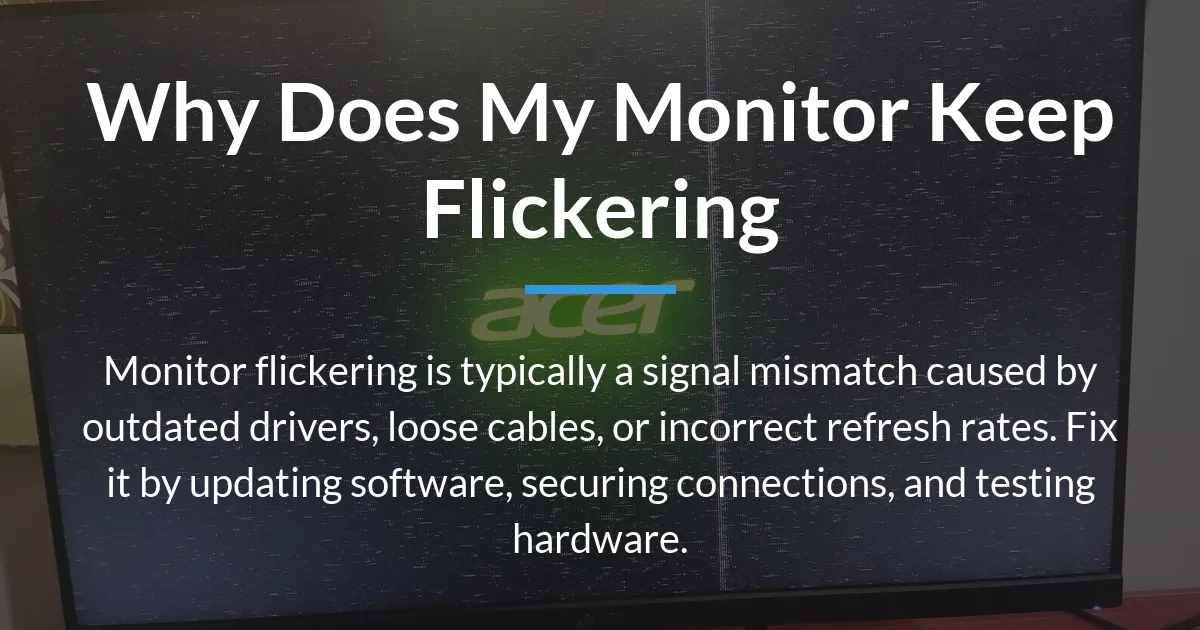
Monitor flashing happens when the video signal between your computer and display becomes interrupted or unstable. Think of it like a conversation where one person keeps cutting out—the other person must keep saying “Can you hear me?” until the connection stabilizes. Your monitor experiences something similar when the signal drops.
Understanding what’s actually happening helps you fix it faster. Your monitor isn’t necessarily broken. The problem is almost always one of five categories, and each requires a completely different solution.
The Five Main Causes of Monitor Flashing
Cable and Connection Problems (60-70% of cases): Loose connections, corroded connectors, or damaged cables create intermittent signal loss. This is by far the most common cause.
Graphics Driver Issues (15-20% of cases): Outdated or corrupted drivers prevent proper communication between your graphics card and monitor.
Refresh Rate Settings (5-10% of cases): Your monitor might be attempting a refresh rate your cable can’t handle, causing signal instability.
Power and Electrical Problems (5-10% of cases): Unstable power delivery, overloaded power strips, or electromagnetic interference disrupts normal operation.
Monitor Hardware Failure (1-5% of cases): Internal components or ports fail, requiring professional repair or replacement.
Proper diagnosis saves time and money. Wrong diagnosis means troubleshooting dead ends. The systematic approach that follows ensures you test the most likely causes first, so you’ll either fix the problem quickly or know exactly what to investigate next.
Cable and Connection Problems (Start Here First)
About 60-70% of monitor flashing stems from cable issues, which is actually good news. This is the cheapest component to test and replace. When a cable begins to fail, it doesn’t typically stop working completely. Instead, it creates intermittent connection drops that make your monitor flash on and off.
Why Cable Issues Cause Monitor Flashing
Video signals require stable electrical connection. When a cable’s internal wires corrode, break, or develop weak spots, the connection becomes intermittent. Movement of the cable worsens the problem—sometimes the cable flexes back into position, restoring signal temporarily, then flexes away again, creating flashing.
Intermittent failure is more frustrating than complete cable failure because it seems random. You might move your monitor slightly and watch the flashing stop, then return when you move it again. This behavioral pattern is a strong indicator that your cable is the problem.
Visual Cable Inspection Checklist
Start by examining the cable connecting your monitor to your computer. Look for bent or kinked connectors, which indicate internal wire damage. Check for frayed insulation, visible cracks, or discolored connector ends that suggest corrosion buildup.
Next, inspect the connection points. Look inside the port on both your monitor and computer for debris or corrosion. Gently try moving the connector—it should be snug without requiring force. If the connection wobbles or moves easily, you’ve found a problem.
Finally, examine how the cable is routed. If it runs under furniture where it could get pinched, or if it’s tightly coiled for storage, internal breaks may have developed. Even if the cable looks fine externally, routing problems often indicate hidden damage.
Pro Tip: Even if your cable looks completely fine, try the reseat method. Unplug the cable completely, wait five seconds, then plug it back in firmly. This simple step removes oxidation buildup inside connectors and fixes approximately 20-30% of cable-related flashing before you try anything else.
Step-by-Step Cable Reseating Procedure
Power down your computer and monitor completely. Wait 30 seconds for power discharge—this prevents electrical shock risk and allows internal components to stabilize.
Locate both ends of your video cable and identify the cable type (HDMI, DisplayPort, DVI, or VGA). Prepare your workspace so you can safely access the connectors without awkward reaching or bending.
Remove the cable firmly from your monitor port using steady hand placement. Avoid excessive force that might damage connectors or ports. Note any resistance or visible damage as you remove it.
Inspect both the connector and the port itself. Look for debris inside the port and clean gently with a dry cloth if needed. Never insert anything metallic into the port. This inspection removes oxide buildup that interferes with connection quality.
Reinsert the cable into the monitor port with steady, firm pressure until you feel it seat completely. You should feel or hear a subtle click. Repeat this same process for the cable’s computer end, ensuring this connection is equally secure.
Power everything back on in sequence: monitor first, then computer. Observe the first 30 seconds carefully. If flashing stops, you’ve found your problem—the connection was simply loose.
If flashing stops after reseating, your diagnosis is correct and you’re done. If flashing continues, proceed to trying a different cable.
Try a Different Cable
Cable swapping is the fastest definitive test. This single variable swap tells you conclusively whether your cable is the problem. Borrow a cable from another device if you have one available—a printer, external hard drive, or colleague’s computer. Alternatively, purchase a budget replacement cable for $15-20 to test before committing to a permanent replacement.
Match the cable specifications correctly. Use an HDMI cable if testing HDMI, DisplayPort if testing DisplayPort. The cable quality matters—if you have access to a newer cable, try it first, as older stored cables often have internal degradation from years of being coiled.
Power down both devices completely. Disconnect your current cable from both ends. Connect the test cable firmly to both your monitor and computer, ensuring secure connections at both ends.
Power devices back on and observe for 5-10 minutes of normal computer use. Move the mouse, open windows, and use your keyboard. Document clearly whether flashing stops, continues, or changes behavior.
If flashing stops with the different cable, your original cable is bad. Purchase a replacement ($15-40) and you’re done. If flashing continues with a different cable, your issue is not cable-related—move to Section 3 (Driver Testing). You’ve now eliminated the most common cause, which is progress.
Important Note: Just because a cable isn’t visibly damaged doesn’t mean it’s functional. Internal breaks develop over time from repeated bending and movement. If a different cable fixes the problem, replace your original cable rather than trying to keep using it.
Try Different Monitor Ports
Most monitors have multiple input ports—typically HDMI, DisplayPort, or both. Sometimes a specific port develops connection issues while other ports remain perfectly functional. This is your next test if cable swapping didn’t solve the problem.
Power down your monitor completely. Unplug your video cable from the current port. Locate a different available port of the same type on your monitor’s back panel. Connect the same cable you’ve been using to this different port firmly.
Power your monitor back on and test for stability over 10 minutes. If flashing stops, you’ve identified a faulty port on your monitor. Use the working port going forward. If flashing continues on the different port, the monitor port isn’t your problem.
Why does one port fail while others don’t? Each port has a dedicated circuit path. Corrosion, physical damage, or age can attack a single port while leaving others unaffected. One port failure doesn’t mean your monitor is dead—it just means you’ll use a different port permanently.
Try Different Computer Ports
Similarly, your computer likely has multiple video output ports. If you have both integrated graphics (built into your motherboard or processor) and a dedicated graphics card, you have multiple ports available. Testing different computer ports isolates whether your computer’s graphics output is causing the problem.
For desktop computers, identify all available video output ports. You might have both a motherboard port and GPU ports available. Unplug your monitor from the current port and connect to a different port of the same or different type.
For laptops, check your specifications for available ports. Modern laptops often have HDMI, USB-C video output, or both. If switching connection types, ensure your adapter is quality—cheap USB-C adapters frequently cause instability.
Test the alternative port for 10 minutes. If flashing stops, you’ve identified a failing computer port. Use the working port going forward. If flashing continues, computer ports aren’t your problem.
This test also reveals whether integrated graphics are causing issues. If you have a dedicated GPU and it has available ports, test using the dedicated card’s port. If that works but integrated graphics port causes flashing, you might need to force your system to use dedicated graphics in BIOS or driver settings.
When to Replace Your Cable
Clear signs your cable needs replacement include visible physical damage confirmed during inspection, multiple test attempts showing continued flashing with the original cable, borrowed cables working fine but your original cable not working, or cables older than 3 years with heavy use showing degradation.
Quality matters when selecting a replacement. A $20-30 cable from a reputable brand will serve you far better than a $5 budget option. Look for cables specified as HDMI 2.0 or higher, or DisplayPort 1.4. Shielded cables resist interference better than unshielded options.
The cost-benefit analysis is clear. A quality replacement cable costs $20-30. Your time investment troubleshooting is validated by this low cost. Avoiding a $300+ monitor replacement makes the cable investment worthwhile.
Graphics Driver Problems (The Sneaky Culprit)
If cable testing didn’t fix your flashing, graphics driver issues are the next most likely cause. Your graphics driver is software that tells your graphics card how to communicate with your monitor. When drivers become outdated or corrupted, this communication becomes unstable—and your monitor flashes.
The frustrating part? Your monitor can be perfectly fine. Your cable can be perfectly fine. But corrupted drivers will still cause flashing, leading you down the wrong troubleshooting path if you don’t know to check drivers.
Understanding Graphics Drivers
Your graphics driver acts as a translator between Windows or macOS and your graphics hardware. It converts instructions from your operating system into commands your graphics card understands. When drivers become outdated, they use outdated instruction sets that newer monitors don’t recognize. When drivers become corrupted, they send scrambled instructions that create unstable signals.
Drivers get corrupted through system crashes during installation, conflicting software interference, partial updates that didn’t finish, or mismatches between your hardware and the software controlling it.
Key Point: If your monitor flashing started right after a Windows update, driver issues are highly likely. Windows sometimes reverts drivers to older versions or creates compatibility problems during updates.
Update Your Graphics Drivers
Graphics driver updates are free and usually take 5-10 minutes. Different graphics card manufacturers have different update procedures, so follow the process matching your specific hardware.
For NVIDIA Graphics Cards: Visit https://www.nvidia.com/Download/driverDetails.aspx in your web browser. Select your graphics card series (GeForce, RTX, GTX). Find your specific GPU model—search “what GPU do I have” in Google if unsure. Select your operating system and click Search. Download the driver file, then run the .exe installer. Follow on-screen prompts and restart when prompted.
For AMD Radeon Graphics Cards: Visit https://www.amd.com/en/support and navigate to Graphics → Drivers & Support. Select your Radeon graphics model, choose your operating system, and download the AMD Radeon Software package. Run the installer, select “Factory Settings” installation, and restart when prompted. AMD consolidated all drivers into “AMD Adrenalin” software—this is the standard going forward.
For Intel Integrated Graphics: Intel graphics are often overlooked but important, especially for laptop and budget desktop users. Visit https://www.intel.com/content/www/us/en/support/detect.html and click “Analyze Now” for automatic detection. Download the Intel Driver & Support Assistant tool and run it to scan your system. Install any graphics driver updates it recommends and restart. Laptop users should check their laptop manufacturer’s support page first—they sometimes customize Intel drivers.
After driver installation completes and your computer restarts, verify the installation was successful. For NVIDIA, right-click your desktop and open the NVIDIA Control Panel to confirm the latest driver version displays. For AMD, open AMD Adrenalin and verify the driver version. Knowing the installation succeeded gives you confidence to test the next step.
Complete Driver Removal and Reinstallation
Sometimes updating drivers isn’t enough. If flashing persists after driver updates, you might need a clean slate. Complete driver removal clears out corrupted files, conflicting registry entries, and leftover installation remnants that can interfere with stability.
Important Warning: Your monitor will look strange between removal and reinstallation—likely showing lower resolution and limited colors. This is completely normal and temporary. Don’t panic if your screen looks broken during this process.
Right-click your Start menu and select “Device Manager.” Find “Display adapters” section and expand it. Right-click your graphics card and select “Uninstall device.” Check the box for “Delete the driver software for this device”—this crucial checkbox ensures complete removal. Click “Uninstall” and wait 30-60 seconds for the process to complete.
Restart your computer. Windows will automatically install basic display drivers during restart—this is why your screen will look different temporarily. Your monitor will function but at lower resolution with standard colors.
Download the latest driver from your graphics card manufacturer’s website using the instructions above. Install this fresh driver on your now-clean system. Restart again. Your system will fully update with the new driver and display correctly.
Why does this work? Complete removal clears corrupted files, conflicting registry entries, and partial installation fragments that can interfere with stability. Fresh installation on a clean system provides maximum stability.
Testing After Driver Update
After updating or reinstalling drivers, monitor your system continuously for 15-30 minutes. Open multiple applications—web browser, documents, even games if you use them. Move your mouse, open and close windows, plug and unplug external USB devices. Intentionally use your computer in varied ways.
Zero flashing during this observation period means success. Monitor completely stable and no visual anomalies indicates your problem is solved. If flashing continues at any point, if it’s intermittent, or if it only happens in specific applications, your issue is not driver-related.
If driver updates fixed your flashing, congratulations! You’ve identified and solved the problem. Your next step is the Prevention section to ensure this doesn’t happen again. If driver updates didn’t help, you’ve ruled out both cables and drivers—move to Section 4 (Display Settings).
Refresh Rate and Display Settings Issues
Your monitor’s refresh rate is the number of times per second it updates the image, measured in Hertz (Hz). Common refresh rates include 60Hz, 75Hz, 100Hz, 120Hz, 144Hz, 165Hz, and higher. If your computer attempts to run at a refresh rate your monitor and cable can’t maintain, the signal becomes unstable—and you see flashing.
This particularly happens when you have a newer high-refresh-rate monitor (144Hz or higher) but an older cable that can’t support that rate. The cable becomes the limiting factor, unable to handle the high-frequency signal transmission required by higher refresh rates.
Accessing Your Display Settings
On Windows 10: Right-click an empty area of your desktop and select “Display settings.” Scroll down to “Advanced display settings.” Look for your monitor model name, then find the “Refresh rate” dropdown, typically near the bottom of the advanced settings screen.
On Windows 11: Right-click your desktop and select “Display settings.” Scroll down to “Advanced” and select “Refresh rate” option. The interface is slightly cleaner than Windows 10 but the functionality is identical.
On macOS: Click the Apple menu, go to “System Settings” (or “System Preferences” on older versions), click “Displays,” and look for a “Refresh rate” option if available. Note that many Macs don’t show refresh rate options for built-in displays—macOS handles these automatically.
If your refresh rate dropdown is grayed out and you can’t change it, your graphics drivers need updating. Go back to Section 3 and update your drivers completely. Alternatively, you might be using integrated graphics when a dedicated GPU is available—switching to dedicated graphics in BIOS settings would resolve this.
The Refresh Rate Testing Protocol
Note your current refresh rate setting by opening Display Settings and looking at the dropdown. Don’t change anything yet—just document what you’re currently running. Write it down for reference.
Now lower your refresh rate to 60Hz. Open Display Settings, click the refresh rate dropdown, select “60Hz,” and apply the change. Restart your computer if prompted. Sixty hertz is the most universal standard that nearly every monitor and cable combination can handle. If 60Hz doesn’t fix your flashing, refresh rate isn’t your problem.
Test for stability over 20-30 minutes. Open web browser, documents, videos, or games. Move your mouse, open and close windows. Observe carefully for any flashing. If the screen looks slightly less smooth at 60Hz, that’s expected—but it should be stable.
If flashing stops at 60Hz, you’ve identified your problem. Your cable can’t handle higher refresh rates. You can either keep using 60Hz (fine for most work), buy a better cable rated for higher rates ($20-30), or switch to DisplayPort if available on your monitor and computer.
If you want higher refresh rates again, incrementally test higher settings. Try 75Hz for 10 minutes. If stable, try 100Hz for 10 minutes. Continue stepping up until you find instability. Use the highest stable rate as your permanent setting.
If lowering to 60Hz didn’t help, refresh rate adjustment isn’t solving your problem. You’ve ruled out another major cause and are narrowing down what’s actually wrong.
Power and Electrical Issues
If cables, drivers, and display settings didn’t fix your flashing, power and electrical issues become the next investigation point. Your monitor needs stable power delivery to function correctly. Unstable power creates intermittent shutdown and restart cycles that appear as flashing.
Check Your Power Cable and Outlet
Examine your monitor’s power cable for physical damage like bent connectors or frayed insulation. Look at the plug prongs for corrosion or discoloration. Check that the power outlet connection is snug—the plug should fit firmly without wobbling.
Feel the outlet with the back of your hand (when the plug is unplugged) to check for heat. A hot outlet indicates potential electrical problems with that circuit. If you smell burning or see scorch marks, stop using that outlet immediately and contact an electrician.
Try connecting your monitor to a different electrical outlet, preferably on a different circuit if your house has multiple circuits. Test for stability over 10-15 minutes. If flashing stops, your original outlet or circuit has a problem. Contact an electrician or stop using that outlet for your monitor.
Avoid Overloaded Power Strips
Power strips have maximum capacity—usually 1500-2500 watts. When total device wattage exceeds capacity, voltage drops and causes instability. High-power devices like microwave ovens (1000-2000 watts), space heaters (1500+ watts), hair dryers (1500-2000+ watts), and gaming computers (400-1000+ watts) shouldn’t share power strips with sensitive electronics like monitors.
If your monitor is on the same power strip with other high-power devices, unplug those other devices. Keep only your monitor connected to the power strip. Plug the power strip directly into a wall outlet, not into another power strip. Test for 15-20 minutes.
If flashing stops, your power strip was overloaded. Redistribute your devices across different outlets going forward. Use separate power strips for different device categories.
Check for Electromagnetic Interference
Electromagnetic interference (EMI) from nearby devices can disrupt your monitor’s video signal. Microwave ovens emit very strong interference. Cordless phones, WiFi routers, cell phones receiving calls or data, and fluorescent lights emit moderate to mild interference.
If your monitor flashes at specific times—like when your microwave runs or when you receive calls on a nearby cordless phone—EMI is likely your problem. Identify the suspected interference source and move it farther away from your monitor. Minimum distance of 3-4 feet often resolves the issue.
Alternatively, try temporarily turning off the suspected device and testing whether flashing stops. If it does, you’ve confirmed your culprit. The solution is simply maintaining distance between interfering devices and your monitor going forward.
Test Another Monitor in Your Setup
Borrow another monitor if possible and plug it into the same power outlet and video connection as your monitor. Use the borrowed monitor for 10-15 minutes and observe whether it also flashes.
If the borrowed monitor works perfectly, your original monitor’s power supply is likely failing. If the borrowed monitor also flashes, your power outlet or circuit is the problem. This test definitively determines whether your monitor itself is failing or your setup is the issue.
Monitor Hardware Issues
If you’ve tested cables, updated drivers, adjusted refresh rate, and checked power—and flashing still occurs—monitor hardware failure becomes likely. Physical damage to ports or internal power supply components can cause flashing that no software adjustment fixes.
Assess Physical Damage
Unplug your monitor and inspect it with a flashlight. Look inside each video input port for bent connector pins, charred plastic, corrosion, or loose components. Check the monitor’s exterior for cracks near ports, burn marks, or other visible internal component damage.
Minor cosmetic damage like dents or scratches doesn’t cause flashing. Severe damage like cracked circuit boards, water damage, or multiple burn marks indicates replacement is likely necessary. Moderate damage like bent pins or single burn marks might be repairable through professional service.
Factory Reset Monitor Settings
Your monitor has an on-screen display (OSD) menu with settings that might be misconfigured. Access this menu by pressing the “Menu” button on your monitor’s bezel (usually a button labeled with a symbol or “Menu” text). Look for “Reset to Factory Defaults” option.
Select “Reset” and confirm when prompted. Your monitor will restart with default settings. This corrects any misconfigured options that might contribute to flashing behavior.
The Definitive Hardware Failure Test
Connect your monitor to a completely different computer if possible. Borrow a colleague’s computer, use your work setup, or go to a friend’s house. Use the same video cable if you can, but borrowed monitor will work even with different cable.
Operate this borrowed computer normally for 15-20 minutes. Open applications, plug/unplug USB devices, change resolution if possible. Observe your monitor carefully.
If your monitor works perfectly on the different computer, your original computer setup is the problem. Return focus to cables, drivers, and settings. If your monitor also flashes on the different computer, your monitor hardware is failing and needs replacement or professional repair.
Advanced Troubleshooting (When Standard Fixes Don’t Work)
If you’ve systematically gone through all previous sections and flashing persists, advanced troubleshooting becomes necessary. These solutions address edge cases and require slightly more technical confidence.
Try Alternative Video Connection Types
If you’ve been using HDMI, try DisplayPort if your monitor and computer support it. Purchase a DisplayPort cable ($15-25), completely disconnect your HDMI cable, and connect via DisplayPort. Test for 20-30 minutes.
Conversely, if you’ve been using DisplayPort, try HDMI. Some hardware combinations work better with specific connection types due to GPU compatibility or specific monitor firmware.
Different connection type working while original type didn’t indicates a hardware compatibility issue. Both connection types having the same problem means connection type isn’t your issue.
Monitor GPU Temperature
Download GPU-Z (free from techpowerup.com) and launch it. Watch your GPU temperature during normal use and especially during gaming. Your GPU should stay under 80°C during normal use and up to 90°C during gaming is acceptable.
If your GPU exceeds 90°C, it’s thermally throttling—automatically reducing performance to cool down. This reduced performance can manifest as display flashing. Solutions include cleaning GPU cooling fins, improving case ventilation, or reducing graphics settings in games.
If temperature is normal but flashing continues, overheating isn’t your problem.
Boot Into Safe Mode
Safe Mode starts Windows with only essential services, disabling third-party software that might interfere. If flashing stops in Safe Mode but returns in normal mode, software or background processes are your problem.
Right-click your Start menu, select “Windows Terminal (Admin),” type “bcdedit /set {default} safeboot minimal” and press Enter. Restart your computer. Press “4” or “F4” when the startup menu appears to boot into Safe Mode.
Test for 15-20 minutes in Safe Mode. If flashing stops, software is your culprit. Update all software and disable startup programs. To exit Safe Mode, open Command Prompt as Administrator and type “bcdedit /deletevalue {default} safeboot,” then restart.
Run Windows Memory Diagnostic
Faulty RAM rarely causes display flashing, but it’s worth testing before giving up. Press Windows key + R, type “mdsched.exe” and press Enter. Select “Restart now and check for problems.”
Let the test run completely (5-30 minutes). After restart, check if errors were found. “No problems found” means RAM is fine. If errors appear, RAM is faulty and needs replacement.
RAM replacement typically costs $30-100 and is straightforward, but RAM errors are uncommon causes of monitor flashing.
Prevention & Long-Term Maintenance
Once you’ve fixed your flashing monitor, prevent recurrence through proper maintenance and care habits.
Cable Management
Store cables loosely—never coil them tightly. Use velcro cable ties, not rubber bands. Keep cables away from heat sources and away from traffic areas where they might get stepped on or moved repeatedly. Inspect cables monthly for visible damage, stiffness, or brittleness.
Replace cables showing wear before they fail completely. Preventive cable replacement costs $20-30. Waiting until total failure means potential $300+ monitor replacement.
Driver and Software Maintenance
Check for graphics driver updates monthly. Visit NVIDIA.com, AMD.com, or Intel.com and download latest drivers for your GPU. Enable automatic Windows updates. Check monitor manufacturer website quarterly for firmware updates.
Latest drivers contain bug fixes for display stability. Monthly checks prevent future problems.
Power and Environment
Use a surge protector ($20-40) to stabilize power and filter electromagnetic interference. Don’t use power strips for multiple high-power devices—distribute devices across different outlets. Keep your monitor at least 3 feet from microwave ovens, WiFi routers, and cordless phones.
Ensure 2+ inches of ventilation behind your monitor. Avoid direct sunlight and heat sources. Use microfiber cloth to clean the monitor screen weekly and dust vents monthly.
Repair or Replace? Making the Right Decision
Use the “50% Rule” to decide whether to repair or replace your monitor. Calculate your repair estimate and current monitor replacement cost. If repair cost exceeds 50% of replacement cost, buy a new monitor. If repair cost is under 30% of replacement, repair makes sense. Between 30-50%, consider other factors like monitor age and your preferences.
For example: New monitor costs $300. Repair estimate is $180. 180÷300 = 60%. This exceeds 50%, so replacement makes financial sense.
Additional factors include monitor age (5+ years old leans toward replacement), brand reputation (premium brands worth repairing, budget brands lean toward replacement), and your personal preference (want an upgrade versus wanting to keep your current monitor).
Frequently Asked Questions
Why Is My Monitor Flashing After Windows Update?
Windows updates sometimes revert graphics drivers to older versions or create compatibility problems. Update your graphics drivers to the latest version from your GPU manufacturer’s website. Visit nvidia.com, amd.com, or intel.com, download the latest driver for your specific graphics card, install it, and restart your computer. If flashing persists after driver update, lower your refresh rate to 60Hz in Display Settings—Windows updates sometimes set refresh rates higher than your cable supports.
How Do I Know If My HDMI Cable Is Bad?
Visual signs include bent connectors, frayed insulation, corrosion on connector ends, and discolored connectors. Behavioral signs include flashing that worsens when you move the cable, flashing that stops temporarily when you wiggle the cable, and flashing that started suddenly without other changes. The quickest test is borrowing or purchasing a different HDMI cable ($15-30) and testing it. If flashing stops with a different cable, your original cable is bad.
Why Does My Monitor Flash Only When Gaming?
Gaming-specific flashing usually indicates either refresh rate incompatibility or GPU overheating. During gaming, your GPU attempts rendering at your monitor’s refresh rate. If your cable can’t handle this high rate, the signal becomes unstable. Try lowering your refresh rate to 60Hz in Display Settings. If that fixes it, your cable is your limiting factor. Alternatively, download GPU-Z and monitor your GPU temperature during gaming. If it exceeds 90°C, your GPU is thermally throttling, which can cause flashing. Clean your GPU cooling fins or improve your case ventilation.
My Monitor Goes Black for a Few Seconds—What Should I Do?
This specific symptom (complete blackout rather than continuous flashing) indicates signal interruption or power cycling. Reseat your video cable firmly on both ends. Try a different power outlet. Unplug monitor for 30 seconds and plug back in. Try different video ports on both monitor and computer. Access your monitor’s on-screen menu and disable “Auto Input Detect” if available. Borrow another monitor if possible and test it in your setup. If borrowed monitor also goes black, your power outlet or computer is the problem. If borrowed monitor works fine, your monitor’s power supply is likely failing.
Is Startup Monitor Flashing Normal?
Monitor flashing only during the first 5-10 seconds of startup, which stops once Windows or macOS loads, is typically normal. Your graphics driver initializes during startup, and brief flickering before full OS load is expected. However, if flashing continues after the OS loads, if it’s increasingly severe, or if your computer doesn’t fully boot, this indicates a problem worth investigating. Update your graphics drivers to latest version and reseat your graphics card if using desktop computer.
Can a Loose Monitor Cable Cause Flashing?
Yes, absolutely. A loose cable is one of the most common causes of monitor flashing. When the connection is loose, the video signal intermittently drops, causing the monitor to flash on and off. Signs of a loose connection include flashing that worsens when you move the cable, flashing that stops temporarily when you wiggle the cable, and flashing that occurs at specific angles. Fix this by firmly reseating the cable—unplug completely, wait five seconds, then plug back in with firm pressure until you feel it click. If the connection won’t tighten, try a different cable or port.
Why Is My Monitor Flashing After I Updated Graphics Driver?
New driver releases sometimes have bugs or incompatibilities with specific monitors. Lower your refresh rate to 60Hz—this fixes many driver-related issues. Alternatively, roll back your driver to the previous version: Open Device Manager, expand Display adapters, right-click your GPU, select Properties, go to Driver tab, and click “Roll Back Driver.” If rolling back works, wait for the driver developer to release a bug fix before updating again. Check online forums before updating new driver releases—others may have encountered issues.
Should I Repair or Replace My Monitor?
Use the “50% Rule”: If repair cost exceeds 50% of replacement monitor cost, replace. If repair cost is under 30% of replacement cost, repair makes sense. Between 30-50%, consider monitor age (5+ years old leans toward replacement), brand reputation (premium brands like ASUS or BenQ worth repairing; budget brands lean toward replacement), and whether you want to upgrade anyway. Check warranty status—if still covered, contact manufacturer for free or discounted repair. Quality monitors now cost $150-250, often less than repair costs.
What’s the Difference Between Flashing and Flickering?
Monitor flashing means the entire screen goes black/dark briefly then returns—complete signal loss at intervals. Monitor flickering means the entire screen appears to shimmer or vibrate continuously—signal present but unstable. Flashing usually indicates software/connection issues (easier to fix). Flickering can indicate hardware problems (harder to fix). For flashing, investigate cables, drivers, settings, and power. For flickering, try raising refresh rate, checking GPU temperature, and updating drivers.
Will Monitor Flashing Get Better or Worse?
Monitor flashing rarely improves without intervention—it typically stays the same or gets progressively worse. Cable damage worsens from repeated movement. Driver issues don’t self-resolve. Power problems persist. Hardware deterioration accelerates. Within 1-2 weeks, flashing usually stays consistent. By week 3-4, flashing typically occurs more frequently. By month 2-3, problems often worsen significantly. Without intervention, complete monitor failure often occurs within months. Fix flashing immediately while fixes are cheap and easy. Early intervention prevents total failure costing $300+ replacement.
Is My Monitor Dead If It’s Flashing?
No. Monitor flashing rarely means your monitor is dead. About 60-70% of cases are fixable cable issues. 15-20% are driver problems. 5-10% are settings or power issues. Only 1-5% involve actual hardware failure. Even hardware failure often means only a specific port or power supply component failed—not the entire monitor. Follow the systematic troubleshooting in this guide. If every troubleshooting step passes and flashing persists, then consider monitor hardware failure. Most likely, you’ll find and fix your problem in the first three sections (cables, drivers, settings).