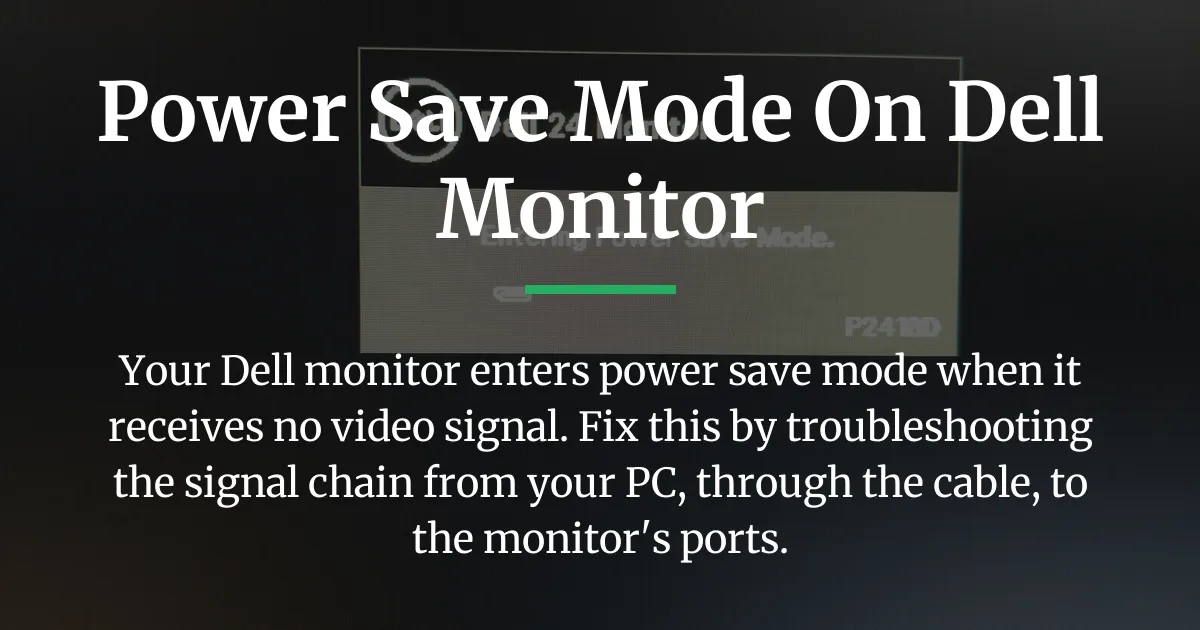
You see a black screen with a message about power save mode, and your Dell monitor simply won’t wake up. This common problem is actually a symptom, as the monitor is correctly reporting a loss of video signal from your computer.
Our guide provides a systematic way to find the real cause, taking you from simple cable checks to advanced computer settings.
Perform a Monitor Soft Reset
A complete power cycle clears the monitor’s internal memory and can resolve a temporary glitch. This is often the fastest solution and the first thing you should try to restore a normal picture.
Turn off both your monitor and your computer using their physical power buttons.
Unplug the monitor’s power cable from the electrical outlet or the back of the monitor itself. You need to disconnect every cable that provides power.
Press and hold the monitor’s power button for a full 15 seconds to drain any remaining electrical charge. If your model does not have a mechanical power button, simply leave it unplugged for several minutes.
Reconnect the power cable firmly to the monitor and then plug it back into the wall outlet. Turn on your computer first and wait for it to fully start up.
Finally, press the power button on your Dell monitor to turn it back on and check for a picture.
Steps for a Complete Power Cycle
First, power down both your computer and monitor completely at the source. Next, disconnect the monitor’s main power cable from its electrical supply to ensure it is off.
Then, hold the monitor’s power button down to discharge any leftover energy in its circuits. Finally, reconnect the power, start your PC, and then turn the monitor on last.
How Your Monitor Detects a Signal
A Dell monitor constantly checks its video ports for an active signal from your computer’s graphics card. It automatically enters a low-power save mode when no valid signal is detected, which is its normal and designed behavior.
The phrase “entering power save mode” is the monitor’s way of telling you the video connection is broken. Your goal is not to fight this mode but to restore the missing video signal that triggers it.
Why Power Save Mode Is Not The Problem
The key misunderstanding is blaming the monitor’s power saving feature for the black screen. In reality, the monitor is working perfectly by going to sleep when it gets no input, just like it should.
The actual fault always lies somewhere upstream in the signal chain before it reaches the monitor. You must shift your focus to finding where that signal is being lost or interrupted.
Check the Video Cable and Connection
Faulty or loose cables are a leading cause of signal loss, making this a critical step. Always inspect the entire length of your video cable for any obvious bends, cuts, or damage to the connectors.
Ensure the cable is plugged in securely at both ends—into your computer’s graphics card port and the correct port on your Dell monitor. A slightly loose connection is enough to cause the “no signal” state.
Inspect and Reseat Your Cables
Unplug and firmly replug your video cable at both the computer and monitor ends. Also check that the monitor’s own power cable is fully seated, as an unstable power supply can cause this problem.
Look closely at the metal pins inside the cable connectors for any that are bent, broken, or missing. Even minor physical damage can prevent a stable signal from getting through.
Try a Different Cable or Port
Swap your current video cable with a new or known-working one to rule out a defective cable. If you are using HDMI, try a DisplayPort or DVI cable instead to test the connection.
Also, try plugging the cable into a different video output port on your computer if one is available. You should also try a different video input port on the Dell monitor itself using its menu controls.
Test the Monitor With Another Device
This test perfectly isolates whether the problem is with the monitor or your computer. Connect your Dell monitor to a different video source, like a laptop, game console, or Blu-ray player, using a good cable.
If the monitor works perfectly with this other device, then the monitor’s hardware is proven functional. This confirmation means the issue is definitely with your original computer or its settings.
If the monitor still shows “no signal” or power save mode with a second known-good device, the problem is likely inside the monitor. At that point, contacting Dell support for hardware service is the logical next step.
Troubleshoot Your Computer’s Video Output
Once you’ve proven the monitor works elsewhere, focus your efforts entirely on your PC. Start by restarting your computer and listening carefully for the familiar startup sounds or login chime.
Hearing those sounds while the screen is black confirms Windows is running without a display signal. This points directly to a software or driver issue with your computer’s graphics output.
Restart and Listen for System Sounds
Perform a full restart of your computer and pay close attention to the audio cues from your speakers. The presence of normal startup noises proves the computer is on but failing to send a video signal to the monitor.
You can also try pressing the Caps Lock key on your keyboard to see if its light toggles on and off. A responsive keyboard light is another strong indicator that the system is on but the display output has failed.
Update or Reinstall Graphics Drivers
Outdated or corrupted graphics drivers are a common culprit for signal problems. Boot your computer into Safe Mode, which uses a basic display driver, to see if the picture returns.
If it works in Safe Mode, visit the website of your graphics card manufacturer (like NVIDIA or AMD) to download the latest driver. Perform a clean installation of the new driver to completely replace any corrupted files causing the conflict.
Check Display Settings in Windows
Incorrect display settings can sometimes tell Windows to output to a non-existent screen. With your monitor connected, press the Windows key + P on your keyboard to open the projection menu.
Cycle through the options, selecting “PC screen only” or “Duplicate” to force a reset of the display output. You can also try this after booting into Safe Mode to access the basic display settings.
Resolve Persistent Power Save Mode Issues
For problems that continue after all basic checks, deeper software or hardware conflicts may be at play. A misconfigured Windows power plan can sometimes turn off a display instantly, mimicking a signal loss.
Access your Windows power options and ensure the plan is set to turn off the display only after a reasonable delay, like 10 or 15 minutes. This rules out an overly aggressive power saving setting from the computer’s side.
Adjust Windows Power Plan Settings
Go to Control Panel > Hardware and Sound > Power Options and click on your active plan’s “Change plan settings.” Look for the setting labeled “Turn off the display” and set it to a longer time, such as 15 minutes or “Never” for testing.
Also, click “Change advanced power settings” and expand the “PCI Express” and “Display” sections. Ensure that the “Link State Power Management” is set to “Off” and any display sleep timers are not set to minimal values.
Inspect Graphics Card Hardware
For desktop PCs, the graphics card itself could be loose or failing. Turn off and unplug your computer, then open the case to locate the graphics card in its slot on the motherboard.
Gently press down on the graphics card to ensure it is fully and firmly seated in its slot. An unstable overclock on the GPU can also cause instability, so reset any overclocking software to default factory settings.
Contact Dell Support with Specific Details
If you have isolated the issue to the monitor’s hardware, gather specific information before you call. Have your Dell monitor’s model number and service tag or serial number ready, which are usually on a label on the back.
Clearly explain all the diagnostic steps you have already performed, such as testing with another computer and trying different cables. Telling them the results of your device test will help them quickly understand the likely type of fault.
Frequently Asked Questions
Can I disable power save mode on my Dell monitor?
You cannot disable the core function that puts the monitor to sleep when there is no signal. You can only extend the wait time before it activates using the monitor’s own On-Screen Display menu under its power management settings.
Why does my Dell monitor go to power save mode when the computer is on?
This means your computer is running but not sending a valid video signal to the monitor. The cause is typically a loose cable, a problem with the computer’s graphics card or its drivers, or an incorrect display setting in Windows.
My Dell monitor says “entering power save mode” then goes black on startup. What does this mean?
This indicates your monitor is turning on normally but receives no signal from your computer during its boot process. The issue is likely with the computer’s initial video output, which points to graphics hardware or a fundamental driver conflict.
How do I wake my Dell monitor from sleep mode if pressing keys doesn’t work?
First, try moving the mouse or pressing any key on the keyboard vigorously. If that fails, perform a full monitor soft reset by unplugging its power cable, holding the power button, and reconnecting it, as detailed in the guide above.
Could a Windows update cause my Dell monitor to get stuck in power save mode?
Yes, a Windows update can sometimes install an incompatible or buggy graphics driver. Booting into Safe Mode and then rolling back or cleanly reinstalling your graphics driver from the manufacturer’s website often fixes this.
Is it safe to unplug and replug my monitor cables while the computer is on?
It is safe to unplug and replug the video cable from the monitor and computer while they are on, a process known as “hot-plugging” for modern connections like HDMI and DisplayPort. You should always turn devices off before unplugging the main power cable from the wall.
My Dell monitor works with my laptop but not my desktop. What’s wrong?
This proves your monitor is fine, so the fault lies with your desktop computer. Focus troubleshooting on the desktop’s graphics card, its driver installation, the specific cable or port you are using, and the desktop’s power supply health.
What should I tell Dell support when I call about a power save mode problem?
Tell them your monitor’s exact model number and serial number, and that it shows “no signal” or power save mode. Explain you have tested it with a different computer and different cables, and clearly state the results of that test.
Does the type of video cable (HDMI, DisplayPort, VGA) affect this issue?
The cable type itself doesn’t cause the issue, but a damaged or poor-quality cable of any type certainly can. Trying a different cable type, like switching from HDMI to DisplayPort, helps test if a specific port on your PC or monitor is faulty.
Could my monitor’s built-in settings or menu be causing this?
It’s possible but less common. Access the monitor’s On-Screen Display menu and ensure the correct video input source is selected. Also, try resetting the monitor to its factory default settings through this menu to clear any incorrect configurations.
Restoring Your Dell Monitor Display
Remember, the power save mode on your Dell monitor is a helpful clue pointing to a broken signal chain. You have learned to methodically check each link, from the computer’s graphics output and software settings through the video cable to the monitor’s own ports.
By following this logical process, you can confidently identify whether you need a simple cable replacement, a driver update, or professional hardware service to get your display working perfectly again.