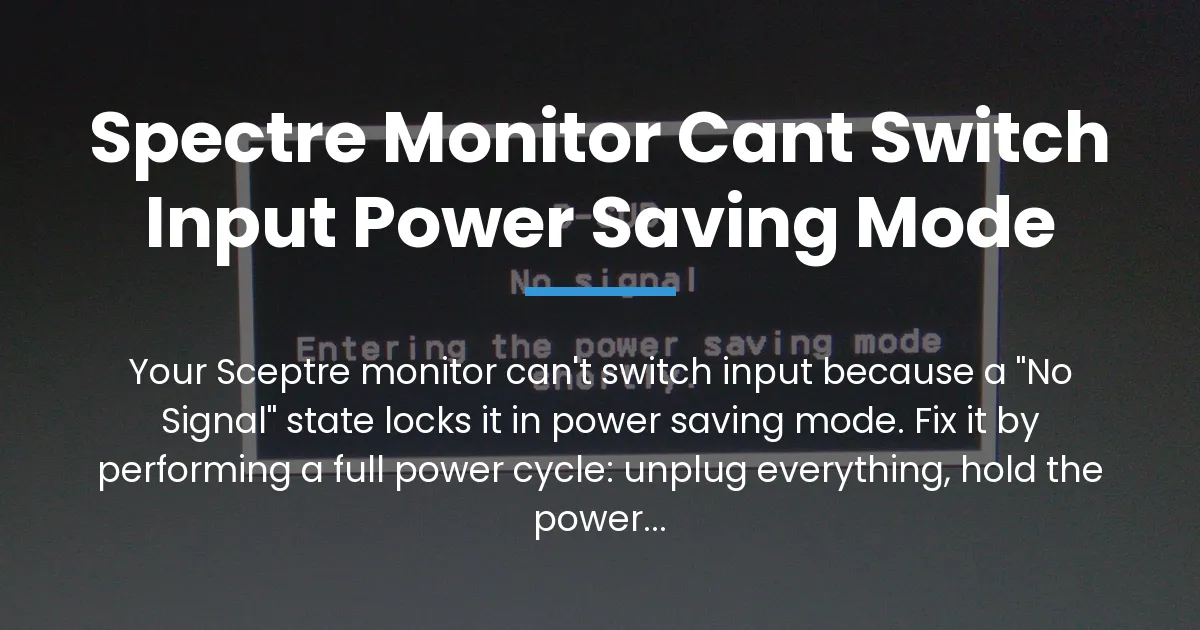
If your Sceptre monitor cant switch input and is stuck in power saving mode, you are facing a double frustration. The screen is black, the buttons seem useless, and nothing you try seems to work. This is a common and often solvable problem. It usually happens because your monitor is stuck in a deep “No Signal” state, which locks down its controls. This guide will walk you through the exact steps to fix it, explain why it happens, and show you how to prevent it from coming back.
The Immediate Reset Sequence to Regain Control
The very first thing you must do is a complete power cycle. This clears the monitor’s memory and resets its connection to your computer. Do not skip any of these steps, as their order is important for success.
- Shut down your desktop computer or laptop completely. Do not just put it to sleep.
- Unplug every video cable from the back of your Sceptre monitor. This includes HDMI, DisplayPort, and VGA cables.
- Also unplug those same cables from your computer or game console.
- Unplug the monitor’s power cord from the wall outlet or power strip. Do not just turn the power strip off.
- With the monitor unplugged, press and hold its physical power button for a full 30 seconds. This drains any leftover power from the internal components.
- Plug only the monitor’s power cable back into the wall. Turn the monitor on. You should see a floating logo or a “No Input” message on the screen.
- Now, reconnect your main video cable (like HDMI) to both the monitor and your computer. Make sure it is pushed in firmly at both ends.
- Finally, turn your computer back on. The monitor should now detect the signal and wake up properly.
Why Your Monitor Locks Inputs in Power Saving Mode
Understanding this is the key to solving the problem for good. Your monitor’s “power saving mode” is usually a symptom, not the real issue. The real issue is that the monitor believes it is getting “No Signal” from your computer.
Here is the logic chain that happens inside your Sceptre monitor. First, it checks for a valid video signal from the cable you have selected. If it does not detect one, it assumes your computer is off. To save energy, it then turns off the display panel and goes into a deep sleep.
In this deep sleep state, many monitors disable their on-screen menu system. The manufacturer does this to prevent errors since there is no picture to display the menu on. This is why your input button or joystick feels dead. The monitor is not broken; its input switching feature is simply locked because it thinks there is nothing to switch to.
When Basic Steps Fail Diagnosing the Signal Chain
If the full reset did not work, the problem is likely somewhere in the chain of communication between your computer and your monitor. We need to test each link separately to find the weak one.
Test a Different Video Source
This step tells you if the problem is with your monitor or with your computer. Find another device that can use the same cable, like a game console, a different laptop, or a streaming stick.
Connect this other device to your Sceptre monitor using the same port and cable. If the monitor works perfectly with the other device, then your original computer is the source of the problem. If the monitor still shows “No Signal,” then the issue is likely with the monitor itself or the cable you are using.
Simplify Your Connection Setup
Many connection problems are caused by extra devices in the chain. Remove any KVM switches, docking stations, cheap adapters, or long cable extensions. Plug your video cable directly from your computer’s output port to your monitor’s input port.
Also, make sure you are plugging into the correct port on your computer. If you have a desktop with a separate graphics card, plug your cable into the ports on the card itself, not the ports on the motherboard near the USB slots. The motherboard video ports are often disabled when a graphics card is installed.
Force a Signal from Your Computer
Sometimes, your computer’s software is not sending a signal the monitor recognizes. We can bypass this software to force a basic signal through.
First, try booting your computer into its BIOS or UEFI settings menu. This menu appears before your operating system loads. If your monitor displays the BIOS screen, then the problem is caused by your Windows or macOS graphics drivers or settings.
If you see the BIOS, then boot into Windows Safe Mode. This loads Windows with minimal drivers. If the monitor works in Safe Mode, you likely need to update or reinstall your graphics card drivers from NVIDIA, AMD, or Intel.
You can also try manually forcing detection. In Windows, right-click your desktop and go to Display Settings. Click “Detect” under the multiple displays section. Sometimes, using a different video cable standard can shock the system awake. If you are using DisplayPort, try an HDMI cable instead, or vice versa.
Computer Settings That Prevent Recurrence
Once your monitor is working again, change a few settings on your computer to stop the “No Signal” state from happening in the first place. The goal is to make sure your computer always sends a tiny bit of signal to the monitor, even when you are not actively using it.
On Windows, go to Start > Settings > System > Power & Sleep. Set both “Screen” and “Sleep” to “Never” while you are at your desk working. You can change these back later if you need to save power when away.
Check your graphics card control panel too. For NVIDIA cards, open the NVIDIA Control Panel, go to “Adjust desktop size and position,” and ensure “Perform scaling on” is set to “GPU.” Sometimes, monitors reject scaling done on the display itself. Also, look for any display power saving modes in these control panels and disable them.
Finally, adopt a simple power-on protocol. Always turn on your desktop computer or laptop first. Wait about 10 seconds for it to start loading the operating system. Then, turn on your Sceptre monitor. This gives the computer time to establish a stable video signal for the monitor to find immediately.
Frequently Asked Questions
Does this mean my Sceptre monitor is permanently broken?
Not necessarily. Most of the time, this is a communication or configuration problem, not a hardware failure. If the monitor works with a different video source like a game console, then the monitor itself is likely fine. Permanent hardware failure is rare and usually shows other signs, like a cracked screen or no power light at all.
Can I fix a monitor stuck in power saving mode without the original remote?
Yes, the physical buttons on the monitor itself are sufficient. The reset procedure relies on the power button, not the remote. The remote is only for convenience and does not provide any special function needed for this fix.
Why does my monitor work with my laptop but not my desktop PC?
This points directly to a problem with your desktop PC. Common causes include a failing graphics card, outdated or corrupted graphics drivers, incorrect output settings in the driver software, or using the wrong video output port on the desktop’s motherboard instead of the dedicated graphics card.
Should I update my monitor’s firmware for input issues?
It is worth checking, but it is not a common solution. Monitor firmware updates are rare and often difficult to apply. Sceptre provides firmware updates only for specific models with known issues. Visit the official Sceptre support website, enter your exact model number, and check the downloads section to see if one is available for your monitor.
Are certain Sceptre monitor models more prone to this problem?
No single model is definitively more prone. This “No Signal” locking issue is a common behavior across many monitor brands and models. However, user reports online often mention curved or ultrawide models, like the C248W-1920RN, likely because they are popular and widely sold, not because they are uniquely faulty.
How do I force my graphics card to detect a monitor in power save mode?
You can force detection through your operating system. In Windows, go to Settings > System > Display > Multiple Displays and click “Detect.” More forcefully, you can boot into Safe Mode, which uses basic video drivers that almost all monitors can understand, forcing a connection. Then update your drivers from there.
Will using a different input port solve this?
It might. If one port on the monitor has a physical hardware fault, switching to another port (e.g., from HDMI 1 to HDMI 2) can provide a working connection. This is a good test during diagnosis. Also, switching from DisplayPort to HDMI can sometimes bypass a failed signal handshake.
Can a faulty power strip cause a monitor to get stuck?
Yes, a bad power strip or wall outlet can cause unstable power delivery. This can make the monitor’s internal electronics reset improperly or not get enough power to fully wake up. Always plug the monitor directly into a known-good wall outlet during troubleshooting to eliminate this variable.
What if the “No Signal” message flashes on and off?
A flashing “No Signal” message often indicates a continuous but failed attempt to connect. This strongly suggests a problem with the video cable or the port on either the computer or monitor. Try a brand-new, high-quality certified cable first. If the problem persists, the video port on your graphics card or monitor may be damaged.
Is this problem covered under the Sceptre monitor warranty?
If the problem is determined to be a manufacturing defect in the monitor’s hardware, it may be covered. However, warranty terms do not cover issues caused by software, incorrect use, or faulty cables from other manufacturers. You must contact Sceptre support directly with your model and serial number to begin a warranty claim.
Final Thoughts on the Input and Power Saving Problem
Getting your display back requires patience and a systematic approach. Remember, the core issue is almost always a lost conversation between your computer and your screen. Start with the full physical reset to clear the state of both devices. If that fails, work your way through the signal chain, testing each component one by one.
By isolating the problem to either the source device, the cable, or the monitor itself, you save valuable time and avoid unnecessary frustration. Once fixed, adjusting a few power settings on your computer can provide a long-term solution, ensuring your Sceptre monitor cant switch input power saving mode problem stays firmly in the past where it belongs.