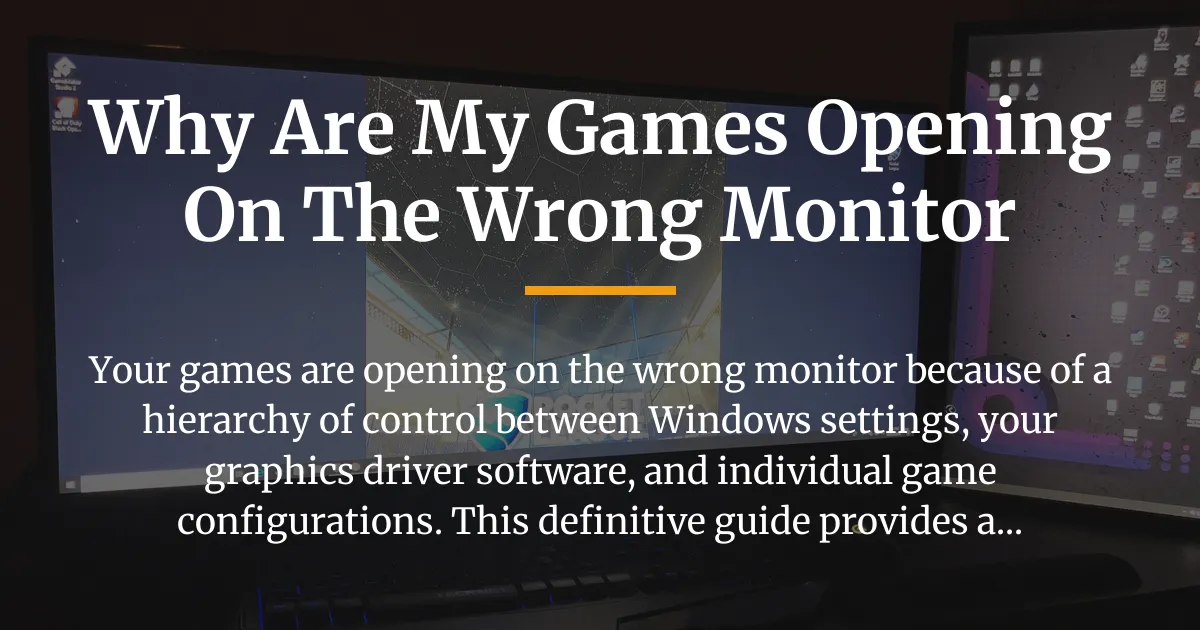
You click play, but your game appears on the secondary screen instead of your main display. This frustrating glitch is a common multi-monitor headache. The core reason is a silent conflict between several systems: Windows, your graphics card driver, and the game’s own engine. This guide will not only solve the immediate problem but also explain the underlying causes. We will follow a clear, tiered approach, starting with a fix you can apply in seconds and progressing to advanced, permanent solutions for even the most stubborn games.
The Immediate Fix: How to Move a Game to the Right Monitor Now
When a game launches on the wrong screen, your first instinct is to get it where you want it without restarting. There are two primary methods that require no deep settings changes, and they work for most games in their current state.
The first and fastest method uses keyboard shortcuts. You need to ensure the game window is the active application. If it is in full-screen mode, you can usually press Alt + Tab to switch to another window and then back to the game, which often makes Windows recognize it as a movable window. Once the game window is active, press the Windows key + Shift + Left or Right Arrow key. This is a built-in Windows command that instantly moves the active window to the adjacent monitor. It is the official shortcut for this task and often works even on stubborn full-screen applications.
The second reliable method involves changing the game’s display mode. Open the game’s settings menu, typically found under “Video” or “Graphics.” Look for an option called “Display Mode” or “Window Mode.” Change this setting from “Fullscreen” to “Windowed” or “Borderless Windowed.” The game will immediately shrink into a window that you can click and drag with your mouse to your preferred monitor. Once it is positioned correctly, go back into the settings and switch the display mode back to “Fullscreen.” The game should now fill the screen on the monitor where you placed the window. Remember, these are excellent troubleshooting steps, but they are often temporary fixes that you might need to repeat.
How Windows and Your GPU Decide Where Games Launch
To find a permanent solution, you must understand the chain of command that determines a game’s launch location. Think of it as a hierarchy where different pieces of software have a say, and sometimes they give conflicting orders. The game itself has a memory, your graphics driver has its own preferences, and Windows sets the overall rules. When these systems disagree, your game lands on the unexpected screen.
At the operating system level, Windows designates one monitor as the “Primary” or “Main” display. This is a software flag, not a physical property of the cable or monitor. Most traditional, full-screen applications are programmed to open on this primary monitor by default. It is the baseline setting that everything else references. The monitor numbering you see in settings is based on your arranged layout and can be manually changed, which directly influences this behavior.
Your graphics card driver software, such as NVIDIA Control Panel or AMD Radeon Software, sits between Windows and the game. It can override Windows’ default instructions. These control panels often have per-application settings where you can assign a specific GPU or monitor for a game’s executable file. If a setting here is configured, it will take precedence, explaining why some games behave differently from others. This layer is a common source of confusion because its settings persist across game updates and Windows restarts.
Finally, the game engine itself plays a crucial role. Games built on engines like Unity or Unreal, or using graphics APIs like DirectX, store their display preferences in configuration files. These are usually simple text files found in your “Documents” or “My Games” folder. They remember the last coordinates where the game window was open. If you last closed the game on your secondary monitor, it might try to reopen there. Furthermore, a display mode called “Full-Screen Exclusive” can complicate things. This mode gives the game direct control over the display output, which can sometimes lock it to a specific GPU port, bypassing the usual window management rules.
How to Set and Change Your Primary Monitor in Windows
Since the primary monitor setting is a fundamental default, correcting it is a vital first step for a permanent fix. The process is nearly identical in Windows 10 and Windows 11, involving just a few clicks in the system settings.
Begin by right-clicking on any empty space on your desktop and selecting “Display settings” from the context menu. This will open the main display configuration page. You will see a diagram at the top representing your monitors, each labeled with a number. If you are unsure which rectangle corresponds to which physical screen, click the “Identify” button to have large numbers flash on each display.
Click on the rectangle that represents the monitor you wish to set as your primary display. Scroll down slightly in the settings panel that appears. Look for a checkbox that says “Make this my main display” (Windows 10) or a dropdown option that says “Use as main monitor” (Windows 11). Select this option. The change is applied immediately. You do not need to restart your computer, but it is a good practice to close and reopen any running games for them to recognize the new primary monitor designation.
Advanced Solutions for Stubborn Games and Permanent Fixes
When the basic methods fail, the problem usually lies in a stronger preference set by your graphics driver or the game platform itself. This tier of solutions involves taking direct control at these levels to enforce your desired behavior. These methods are designed to be set once and work permanently, surviving game patches and system reboots.
Forcing Monitor Selection Through Your Graphics Driver
Your NVIDIA or AMD graphics control panel is a powerful tool for managing where applications render. This method creates a dedicated profile for a specific game, telling your GPU exactly where to display it every time. For NVIDIA users, right-click your desktop and open “NVIDIA Control Panel.” Navigate to “Manage 3D settings” in the left pane, then click the “Program Settings” tab. Here, you add the game’s main executable file (.exe) by clicking “Add” and browsing to its installation folder. Once selected, find the setting called “Preferred graphics processor” or “Multi-display/mixed-GPU acceleration.” You may need to look for a “Monitor” or “Display” specific option depending on your driver version. Set this to your preferred monitor or GPU. For AMD Radeon Software, the process is similar. Open the software, go to the “Graphics” tab, and find the “Games” section. Add your game profile and look for display or monitor assignment options within its settings.
Using Launch Commands in Steam and Other Platforms
Game distribution platforms like Steam and the Epic Games Launcher allow you to pass special commands, called launch options or arguments, to a game when it starts. These can force a windowed state on a specific monitor. In your Steam library, right-click the game and select “Properties.” In the “General” tab, you will find a box labeled “Launch Options.” Here, you can enter commands. A very effective combination is -windowed -w 1920 -h 1080. This forces the game to start in a window at 1920×1080 resolution on your primary monitor, after which you can often switch it to fullscreen. Another useful command is -popupwindow, which creates a borderless window that behaves like fullscreen but is easier for Windows to manage. For non-Steam games, check the launcher’s settings; the Epic Games Launcher and others often have similar fields for game arguments.
The Nuclear Option: Steam Big Picture Mode Settings
If a Steam game consistently ignores all other settings, Steam’s Big Picture Mode has its own display overrides. This is especially useful for games launched from a living room setup. First, open Steam and activate Big Picture Mode using the button in the top right. Once in Big Picture Mode, navigate to the “Settings” cog icon, then select “Display.” Here, you can set a specific “Default Screen” for Big Picture Mode and the games launched from it. This setting forces all Big Picture sessions to target that monitor. It is a sledgehammer approach, but for games that only misbehave when launched through this interface, it is the definitive fix.
Game-Specific Troubleshooting and Known Issues
The reality of PC gaming is that not all games are created equal, especially when it comes to multi-monitor support. Some titles, due to older engines, unique programming, or specific porting issues, have well-known quirks. This section addresses those exceptions, linking the general solutions above to the specific problems you might encounter with popular games.
League of Legends: This game has historically had issues with multi-monitor setups. The most reliable fix is often to use the launch argument method within the Riot Client. Adding --windowed --width=1920 --height=1080 to the game’s settings can force a correct windowed launch. Alternatively, running the game in borderless windowed mode from its in-game settings tends to provide more stable monitor behavior.
Escape from Tarkov: This game is known for its strict full-screen exclusive mode. Players have found success by first ensuring Windows’ primary monitor is set correctly. If the problem persists, using the graphics driver method to assign the game’s .exe file to the correct monitor in the NVIDIA Control Panel or AMD Software is frequently the only working permanent solution.
Older or Niche Titles: Games built on legacy engines or smaller indie projects might simply have broken multi-monitor detection. In these cases, your best bet is to run the game in a windowed mode permanently or use third-party window management software to force its position. The advanced launch commands or driver-level fixes are your primary tools for these stubborn cases.
The Proactive Prevention Checklist
After solving the problem, you can take steps to ensure it rarely, if ever, happens again. Adopting these habits transforms you from a frustrated troubleshooter into an informed user who controls their setup. The goal is to align all the systems we discussed so they work in harmony from the start.
First, always establish your preferred primary monitor in Windows before you install or play a new game. This creates a consistent default for all applications. Second, develop the habit of closing your games on the monitor where you want them to open next time. Since many games remember their last window position, this simple act trains the game’s configuration file. Third, consider using “Borderless Windowed” mode as your default in-game display setting where performance permits. This mode offers the visual immersion of fullscreen while allowing Windows to manage the window placement more easily, making it simpler to move with shortcuts or mouse drags.
Frequently Asked Questions About Games and Monitors
Why does this only happen with some of my games?
This variation occurs because different games use different graphics engines and handle full-screen modes uniquely. Modern, well-maintained engines typically have robust multi-monitor detection. However, older engines or games using specific, less-common graphics APIs might have poor support for multiple displays. They might rely solely on the Windows primary monitor setting from years ago or have bugs in how they read the monitor layout. This is why a one-size-fits-all fix does not exist, and game-specific troubleshooting is sometimes necessary.
Will unplugging my monitor to fix this damage my hardware?
Physically unplugging a monitor to force Windows to reset its display detection is a drastic, temporary workaround. Hot-plugging HDMI or DisplayPort cables is generally safe for modern computers and monitors, but it is not recommended as a regular solution. The sudden disconnection can cause software glitches, and it does not address the root cause. It is far better for system stability to use the software-based permanent fixes outlined in this guide, such as adjusting the primary monitor setting or using graphics driver controls.
I use a laptop with a second monitor. Does that change anything?
Yes, laptop setups add a layer of complexity. Most laptops use hybrid graphics, meaning they have both a power-efficient integrated GPU (like Intel Iris Xe) and a high-performance dedicated GPU (like an NVIDIA GeForce). Windows must decide which GPU to use for the game. If a game is assigned to the integrated GPU by default, its display output might be locked to the laptop’s internal screen. To fix this, go to Windows “System Settings,” then “Display,” and scroll to “Graphics settings.” Add your game’s .exe file here and set its graphics preference to “High performance” to ensure it uses the dedicated GPU, which properly manages external monitor outputs.
Understanding why are my games opening on the wrong monitor is the key to a lasting solution. By recognizing the hierarchy between your operating system, graphics driver, and game files, you can diagnose and fix the issue with precision. Start with the simple keyboard shortcut, verify your primary monitor, and escalate to driver or launch command fixes for stubborn titles. With this structured approach and proactive habits, you can reclaim control over your multi-monitor gaming experience and enjoy your games exactly where you intend them to be.