
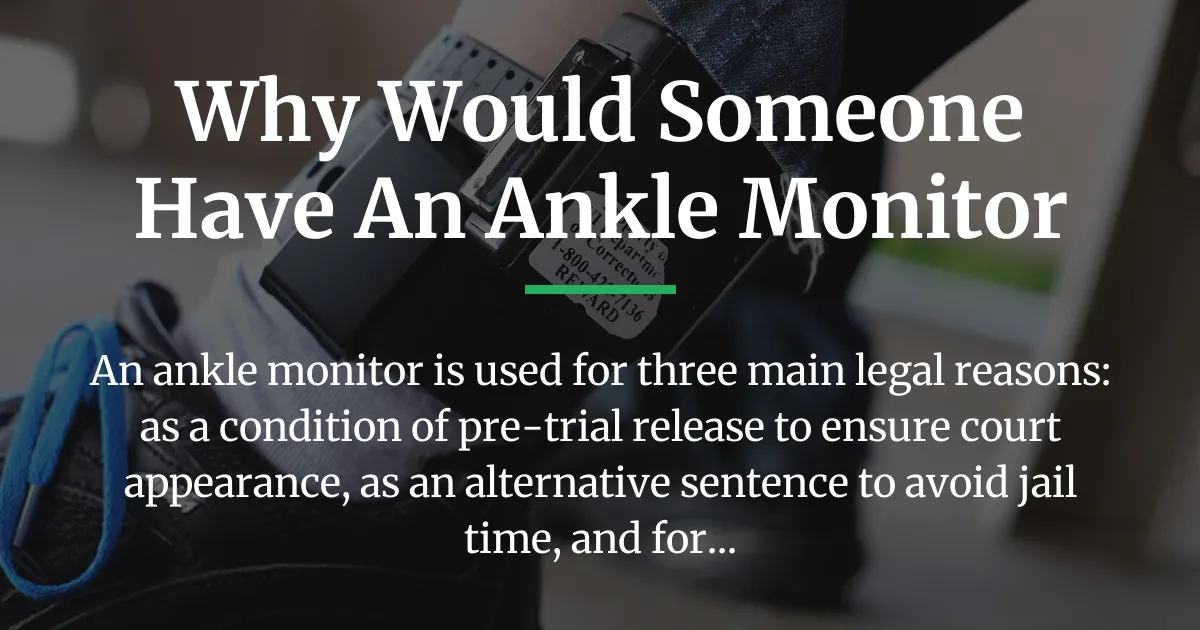
You see it from the corner of your eye, a bulky plastic cuff strapped to a person’s ankle, maybe at the grocery store or on a city bus. Your mind jumps to dramatic scenes from TV shows and news headlines. It is easy to assume the worst, to think you are looking at someone dangerous. But the real story is almost always more complicated and far less sensational. The question of why someone would have an ankle monitor is not about a single type of person or a single terrible crime. It is about the modern legal system trying to balance punishment, public safety, and practical reality.
An ankle monitor, more accurately called an electronic monitoring device, is a tool. Judges and correctional officers use it as a flexible alternative to locking someone in a jail cell. It serves many purposes for many different people. It can keep track of someone who has been accused of a crime but is presumed innocent. It can be a punishment that allows a convicted person to keep their job and support their family. It can enforce a court order to stay away from a specific person or place. To understand it is to look past the dark stereotype and see a piece of technology woven into the fabric of the justice system, affecting hundreds of thousands of lives for reasons that might surprise you.
The Core Reasons: A Legal Framework
Every single use of an ankle monitor falls under one of three broad legal umbrellas. This framework is the key to making sense of all the specific examples you might encounter. The law uses these devices at very different stages of a person’s journey through the courts and corrections.
Pre-Trial Release: Innocent Until Proven Guilty
This is one of the most important and often misunderstood reasons. In the United States and many other countries, a person is presumed innocent until a court finds them guilty. Keeping someone in jail before their trial is a serious matter. It disrupts their life, their job, and their family, all before any conviction. However, a judge might believe the person is a “flight risk,” meaning they might not show up for court, or a potential danger to the community.
An ankle monitor becomes a middle-ground solution. Instead of sitting in jail for months waiting for a trial, the defendant can be released to live at home. The monitor acts as a guarantee. It tells the court, “I am here, and I will appear for my day in court.” For people charged with non-violent offenses, especially first-time offenders, this can be a critical option. It upholds the principle of innocence while addressing the court’s need for oversight.
Alternative Sentencing: Instead of a Jail Cell
After a person is convicted of a crime, the judge must decide on a sentence. Jail or prison is not the only answer. For certain crimes and certain offenders, a judge may decide that incarceration is not the best path. The goals might be rehabilitation, reducing overcrowded jail populations, or allowing the person to keep working to pay restitution to a victim.
Here, an ankle monitor becomes part of the sentence itself. It might be part of a probation order or a term of “house arrest.” The person serves their time in the community, under strict supervision, rather than behind bars. This allows them to maintain employment, attend treatment programs, and support their dependents, all while being monitored. It is a punishment that restricts freedom heavily but avoids the high cost and potential negative effects of imprisonment.
Post-Release Supervision: Parole and Early Release
When someone is released from prison before the end of their full sentence, they are almost always placed under supervision. This is called parole. Similarly, someone finishing a jail term might move to probation. This transition period is critical. The person is back in society but must follow strict rules to stay out.
An ankle monitor provides parole or probation officers with a constant stream of information. It helps ensure the person is following curfews, staying away from forbidden areas like gang territories or a victim’s neighborhood, and going to mandated appointments. It is a tool for reintegration, offering a level of security for the community and a structured framework for the person trying to rebuild their life. A violation, like leaving a designated area, can result in an immediate return to custody.
How the Crime Shapes the Monitor
The type of alleged or convicted offense directly influences why a monitor is ordered and what it is designed to do. The device is not one-size-fits-all; its function is tailored to the specific risks and court orders involved.
| Type of Offense | Typical Legal Context | Likely Monitor Function & Reason |
|---|---|---|
| Domestic Violence | Pre-Trial Release or Probation | Exclusion Zone Enforcement. The primary goal is victim safety. A GPS monitor creates a virtual boundary around the victim’s home, workplace, and school. Any violation triggers an instant alert to authorities. |
| DUI / Drunk Driving | Probation or Alternative Sentencing | Sobriety & Location Tracking. A judge may order a SCRAM device (which tests sweat for alcohol) to ensure continuous sobriety. Often combined with a location monitor to enforce a curfew or ban from bars. |
| Theft, Fraud, Property Crimes | Pre-Trial or Probation for non-violent offenders | Flight Risk Management. For offenders deemed non-dangerous, the main concern is ensuring they appear in court or abide by probation. A basic location monitor confirms they are where they are supposed to be, allowing them to work and pay restitution. |
| Probation or Parole Violations | Post-Release Supervision | Strict Compliance. After a “technical violation” (like missing a meeting with an officer), a monitor may be added to existing terms. It acts as a last-chance warning before incarceration, enforcing all rules with high precision. |
| White-Collar & Financial Crimes | Pre-Trial Release or Sentencing | Low-Risk Supervision. Defendants charged with embezzlement, tax fraud, or similar crimes are often seen as low flight risks and no physical danger. A monitor allows release so they can assist in their defense and organize their affairs, while providing the court with a guarantee of their presence. |
This table shows the logic of the courts. A violent threat demands a monitor focused on protecting a potential victim. A substance abuse issue demands a monitor focused on behavior change. A financial crime demands a monitor focused on ensuring compliance with the legal process. The device is a specific solution applied to a specific set of court-defined problems.
The Technology Behind the Anklet
When people say “ankle monitor,” they are usually referring to the visible plastic band. But the important part is the technology inside it. Different technologies serve different legal purposes, and understanding this breaks down the idea that all monitors are the same.
GPS Location Monitors
This is the most common type people imagine. It uses the Global Positioning System, the same satellite network used by your phone or car. The device constantly calculates its location, often logging data every minute or so. This data is transmitted, usually via a cellular network, to a monitoring center.
A judge can use this technology in two key ways. First, it can track a person’s movements throughout the day, creating a detailed map of where they have been. Second, and more powerfully, it can create “exclusion zones” and “inclusion zones.” An exclusion zone is a forbidden area, like a victim’s street. An inclusion zone is a required area, like a person’s home during curfew hours. Any crossing of these virtual lines generates an immediate alert.
Radio Frequency (RF) Monitors
This older, simpler technology is often used for strict home confinement or curfew enforcement. It does not track location around the city. Instead, a small base unit is plugged into a phone line or cellular outlet in the person’s home. The ankle device communicates with this base unit over a short radio frequency.
The rule is simple: the wearer must be within a certain range of the base unit (usually 100-200 feet) during specified times. If they go beyond that range, the base unit cannot detect the ankle device, and a violation is recorded. This is a lower-cost option for cases where the court only cares about whether the person is at home during curfew, not where they go during the day.
SCRAM (Alcohol Monitoring) Devices
SCRAM stands for Secure Continuous Remote Alcohol Monitor. This is a different tool for a completely different purpose. It does not track location. Instead, it tests for the presence of alcohol in a person’s system through their sweat, taking a sample from the skin every 30 minutes.
The device uses a method called transdermal testing. As the body metabolizes alcohol, tiny amounts are released through the skin. The SCRAM cuff collects this data and transmits it daily. It can detect not just if someone has been drinking, but patterns of consumption. This is crucial for DUI offenders where court-ordered sobriety is the primary condition of release. It is common for a judge to order both a GPS monitor (for location curfews) and a SCRAM device (for sobriety) for a single person, which explains the rare sight of “two monitors.”
Life on a Monitor: Rules and Reality
The legal reasons and technology are one side of the story. The other side is the daily human experience of wearing the device. This reality fills the gap between a court order on paper and a life lived under constant electronic surveillance.
The Unbreakable Daily Ritual
Life revolves around the device’s battery. Most monitors have a battery life of 12 to 24 hours. This means the wearer must plug the device into a charger, connected to a wall outlet, for several hours every single day without fail. This charging usually must happen at the “home base” location approved by the monitoring agency. A dead battery is not an inconvenience; it is a major violation that sends an instant alert and can lead to a warrant for arrest. Planning any part of a day requires working around this mandatory charging window.
Navigating Work and Social Life
Employment is a major challenge. The wearer must disclose their legal status to their employer if the monitor is visible or if work hours conflict with curfew. Many employers are hesitant, leading to job loss or an inability to find work. For jobs that require travel, client meetings, or being in sensitive locations (like schools, which are often exclusion zones), it can be impossible. Socially, the stigma is heavy. The bulky cuff cannot be hidden by long pants in all situations, like at a gym, beach, or during a medical exam. The wearer faces constant potential for judgment, shame, and social isolation from people who do not understand their specific situation.
Dealing With False Alerts and Technical Glitches
The technology is not perfect. A GPS monitor might lose signal inside a large concrete building, like a mall or hospital, and register a “tamper” or “loss of contact” alert. The monitoring company then typically calls the wearer immediately to confirm their location. RF monitors can give false violations if the home base unit has a power outage or internet disruption. Even something as simple as taking a shower can sometimes trigger a tamper alert if water gets into the seal. The wearer lives with the low-grade anxiety that a system error could be mistaken for a willful violation, potentially upending their life.
The Financial and Personal Burden
Electronic monitoring is rarely free. In most jurisdictions, the wearer is required to pay a daily or weekly fee to rent the equipment and for the monitoring service. These fees can range from five to twenty-five dollars per day, adding up to hundreds of dollars a month. For someone already facing legal fines and potentially lost income, this is a significant financial strain. Beyond money, there is a profound loss of privacy and spontaneity. Every movement is logged and analyzed. A quick, unplanned errand is not possible. The mental weight of being constantly watched, of knowing any mistake is recorded, creates a unique and enduring stress.
Dispelling Myths
Popular culture has created a distorted image of who wears an ankle monitor and why. It is time to separate Hollywood fiction from the much more common, and often less dramatic, reality.
Myth: Only Violent Felons and Mob Bosses Wear Them
Reality: While violent offenders can be placed on monitors, especially with exclusion zones for victim protection, they represent only a portion of users. The system increasingly uses monitoring for people it considers *lower* risks, not higher ones. The goal is to keep jail space available for those who truly need to be there. A first-time offender arrested for shoplifting, a professional charged with a regulatory violation, or a parent in a contentious custody case are all far more likely to encounter an ankle monitor than a fictional crime lord.
Myth: It Is a “Slap on the Wrist”
Reality: For the person wearing it, house arrest with electronic monitoring is often described as more psychologically difficult than a short jail sentence. Jail, while harsh, has a defined routine and an end point. Life on a monitor is a form of suspended animation in your own home. The constant surveillance, social stigma, restrictions on movement, and financial costs create a pervasive pressure that lasts for months or years. It is a severe restriction of liberty, chosen by courts specifically because it is a punitive alternative to incarceration, not an easy way out.
Myth: If You See One, You Should Be Afraid
Reality: The presence of a monitor is, ironically, often a sign that the justice system has actively decided the person is *not* an immediate physical threat that requires jail. It means a judge or officer believes the person can be managed in the community with the right safeguards. The person you see could be anyone: a neighbor who made a mistake, a coworker dealing with a private legal matter, or a student navigating a pre-trial process. The monitor itself is a tool of oversight, and in many cases, its presence indicates a path toward rehabilitation and compliance, not escalating danger.
Frequently Asked Questions
Why would someone have two ankle monitors?
This is unusual but happens when the court needs to enforce two separate types of restrictions simultaneously. The most common combination is a GPS location monitor and a SCRAM alcohol monitor. A judge might order this for a repeat DUI offender on probation: the GPS enforces a curfew and keeps them away from bars, while the SCRAM ensures they remain completely sober. Two devices mean two independent forms of supervision for two distinct behavioral requirements.
Can you travel or go on vacation with an ankle monitor?
Routine travel or vacation, as most people think of it, is almost never permitted. Any movement outside of pre-approved areas (like your home, workplace, and a direct route between them) requires advanced, written permission from your supervising probation or parole officer. Even a trip to a different city for a family emergency would need immediate authorization. Unauthorized travel is a serious violation that results in alerts and likely arrest. The concept of a “vacation” is incompatible with the core purpose of confinement and location tracking.
How long does the battery last, and what happens if it dies?
Modern ankle monitor batteries typically last between 12 and 24 hours on a full charge. The wearer is given a strict daily schedule for charging, usually requiring the device to be plugged in for 2 to 4 hours at a specific location. If the battery dies outside of this schedule, it triggers an immediate “power loss” or “tamper” alert at the monitoring center. This is treated as a major violation. The monitoring company will attempt to contact the wearer right away. Failure to resolve it promptly will result in a report to the supervising officer, who will likely seek a warrant for the wearer’s arrest for violating the terms of their release.
Are ankle monitors used the same way in other countries?
The core legal principles are similar in many developed nations, such as the United Kingdom, Canada, and Australia. They are used for pre-trial release, alternative sentencing, and post-release supervision to reduce prison overcrowding and aid rehabilitation. However, the specific policies, how commonly they are used, the technologies preferred, and who pays for them can vary significantly. Some countries may use them more for youth offenders or for specific immigration-related detention alternatives. The details are always dictated by that nation’s own laws and correctional philosophies.
Can the monitor get wet?
Most modern electronic monitoring devices are water-resistant but not fully waterproof. This means they can withstand sweat, rain, or a brief, careful shower. However, they are not designed for submersion. Activities like swimming, taking a bath, or prolonged exposure in a shower are almost always prohibited. Submerging the device can damage its electronics, trigger a tamper alert, and lead to a violation. The wearer receives explicit instructions on the limited water exposure allowed, and violating these instructions is considered tampering with the equipment.
The sight of an ankle monitor will always provoke curiosity and perhaps unease. But now you know that the story it tells is not a simple one. It is a story about legal strategy, about a second chance, about a punishment served in the open world, and about the complex balance between a community’s safety and an individual’s freedom. It represents a point on a spectrum between full liberty and full incarceration. The reasons someone would have an ankle monitor are as varied as the people who wear them, rooted not in stereotype but in the practical, daily workings of the justice system seeking solutions beyond the prison wall.